Introduction
Educational institutions manage thousands of student records, attendance entries, fee transactions, examination results, and staff data every day. Handling these operations manually is time-consuming and error-prone. This is where Education ERP software becomes essential.
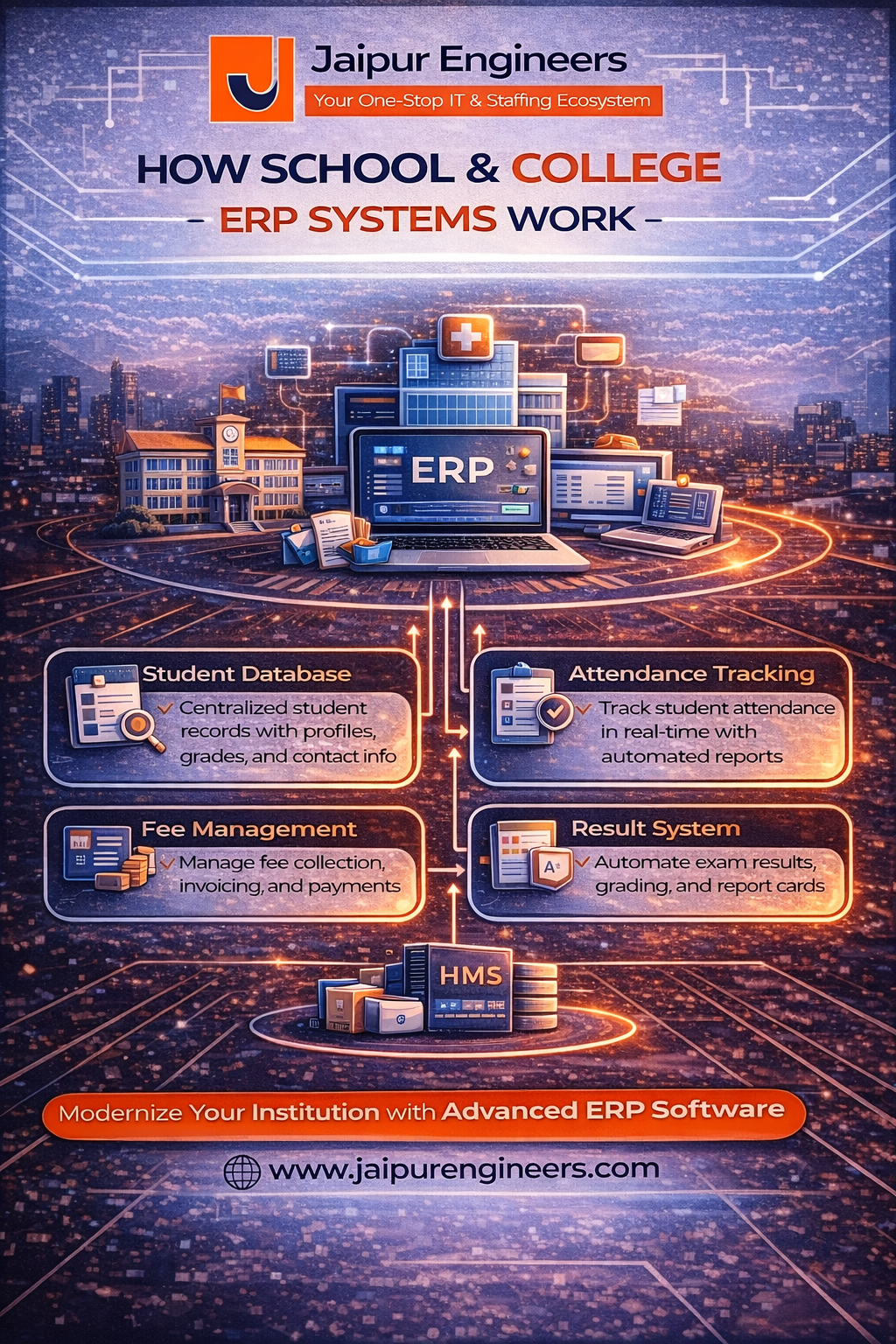
In this blog, we explore how a college management system works, including student databases, attendance tracking, fee management, result systems, and overall system architecture.
What Is an Education ERP System?
An Education ERP (Enterprise Resource Planning) system is an integrated software solution that automates and manages academic and administrative processes in schools and colleges.
It helps institutions:
- Maintain student records
- Track attendance
- Manage fees and billing
- Handle examination results
- Monitor staff and academic performance
A centralized system improves efficiency, transparency, and communication.
1. Student Database Management
The student database is the foundation of any college management system.
It stores:
- Personal information
- Admission details
- Course enrollment data
- Academic history
- Contact information
The database must be well-structured and secure to ensure fast access and data accuracy.
2. Attendance Tracking System
Attendance tracking is one of the most widely used modules in Education ERP software.
Features include:
- Daily attendance entry
- Biometric or RFID integration
- Automated attendance reports
- Parent notifications
- Monthly attendance summaries
Digital attendance systems reduce manual paperwork and increase transparency.
3. Fee Management Module
The fee management system handles financial operations.
It includes:
- Fee structure setup
- Online payment integration
- Receipt generation
- Due date reminders
- Scholarship or discount management
Automated fee tracking reduces errors and improves financial accountability.
4. Examination & Result System
The result system manages academic performance.
It covers:
- Exam scheduling
- Marks entry
- Grade calculation
- Report card generation
- Performance analytics
Automated grading systems save time and minimize calculation errors.
Technical Architecture Overview
A typical school or college ERP system includes:
- Web-based frontend dashboard
- Backend server handling logic
- Centralized database
- Role-based access control (Admin, Teacher, Student)
- Cloud hosting infrastructure
Security is critical because student data is sensitive and must be protected.
Benefits of Education ERP Software
Implementing a college management system provides:
- Improved administrative efficiency
- Real-time data access
- Better communication between staff and parents
- Accurate financial tracking
- Data-driven academic decisions
Digital transformation in education is accelerating, making ERP systems increasingly important.
Conclusion
Education ERP software simplifies complex academic and administrative tasks. From student database management and attendance tracking to fee management and result systems, these platforms centralize operations into one efficient system.
As educational institutions continue to adopt digital solutions, demand for skilled developers in education technology will grow significantly.
For students and IT professionals, understanding how school and college ERP systems work opens strong career opportunities in EdTech development.