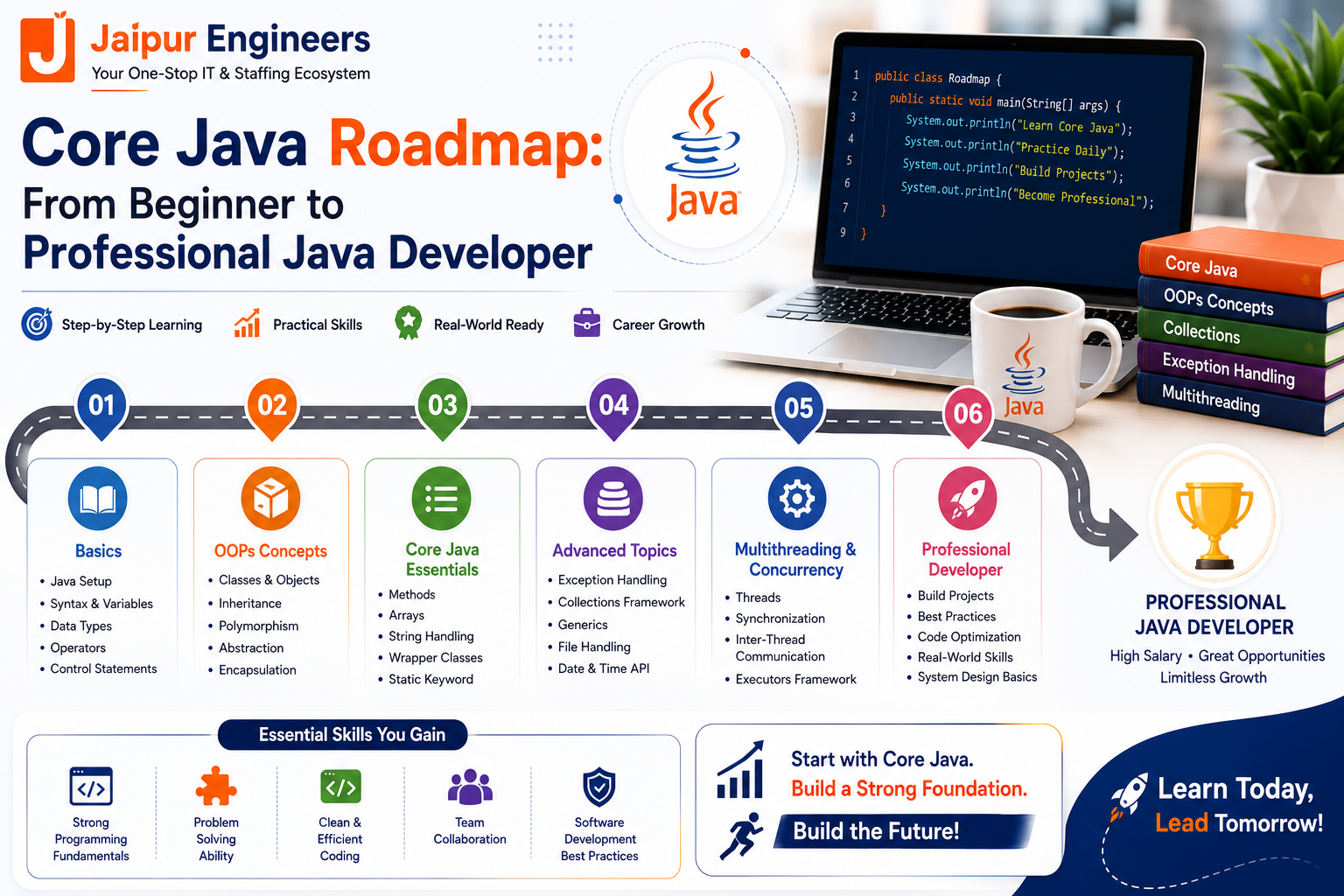
Starting your journey in software development can feel overwhelming, especially with so many programming languages and technologies available today. If you’re planning to become a software developer, Core Java is one of the best places to begin. It provides a strong foundation in programming, object-oriented concepts, problem-solving, and application development that prepares you for advanced Java technologies and enterprise software development.
However, many beginners complete a Core Java course and then wonder, “What should I learn next?” The answer lies in following a structured roadmap. Instead of learning random technologies, you should build your skills step by step—from Java fundamentals to backend frameworks, databases, APIs, version control, and real-world projects.
This guide explains the complete Core Java Roadmap for 2026. Whether you’re a student, graduate, or working professional, this roadmap will help you become a job-ready Java Developer with confidence.
Why Start with Core Java?
Core Java is the foundation of the Java ecosystem. Before learning Spring Boot, Hibernate, Microservices, or Full Stack Development, you must understand the fundamentals of Java programming.
Core Java helps you develop:
- Programming Logic
- Problem-Solving Skills
- Object-Oriented Programming (OOP)
- Code Reusability
- Error Handling
- Memory Management
- Software Development Best Practices
These skills are essential for every Java Developer.
Step 1: Learn Java Fundamentals
The first step is mastering the basics of Java.
Topics include:
- Introduction to Java
- JDK, JRE & JVM
- Variables
- Data Types
- Operators
- Input & Output
- Control Statements
- Loops
- Methods
- Arrays
- Strings
Spend time practicing these concepts with small coding exercises before moving to advanced topics.
Step 2: Master Object-Oriented Programming (OOP)
Object-Oriented Programming is one of the most important concepts in Java.
Focus on:
- Classes & Objects
- Constructors
- Encapsulation
- Inheritance
- Polymorphism
- Abstraction
- Interfaces
Most Java interview questions revolve around these concepts, so ensure you understand both theory and practical implementation.
Step 3: Learn Exception Handling
Professional applications must handle errors gracefully.
Topics include:
- try-catch
- finally
- throw
- throws
- Custom Exceptions
Exception handling improves application reliability and user experience.
Step 4: Understand Collections Framework
The Collections Framework is widely used in enterprise applications.
Learn:
- ArrayList
- LinkedList
- HashSet
- TreeSet
- HashMap
- TreeMap
- Iterator
- Comparable
- Comparator
Understanding collections helps you manage and manipulate data efficiently.
Step 5: Learn Multithreading
Multithreading enables Java applications to perform multiple tasks simultaneously.
Topics include:
- Thread Class
- Runnable Interface
- Thread Lifecycle
- Synchronization
- Thread Safety
Multithreading is commonly used in enterprise and high-performance applications.
Step 6: Practice File Handling
File handling allows applications to read, write, and manage files.
Topics include:
- File Class
- FileReader
- FileWriter
- BufferedReader
- BufferedWriter
- Serialization Basics
This knowledge is useful when developing desktop and enterprise applications.
Step 7: Learn JDBC and SQL
Almost every Java application interacts with a database.
You should learn:
- JDBC Architecture
- Database Connectivity
- CRUD Operations
- MySQL
- Prepared Statements
- Transactions
Strong database skills are essential for backend development.
Step 8: Practice Coding Daily
Programming improves through practice.
Recommended exercises:
- Pattern Programs
- Number Programs
- String Problems
- Array Problems
- OOP Challenges
- Logical Problems
Regular coding practice improves problem-solving skills and interview confidence.
Step 9: Build Mini Projects
Projects help you apply theoretical concepts in practical scenarios.
Recommended beginner projects:
- Student Management System
- Library Management System
- Banking Application
- Employee Management System
- ATM Simulator
- Inventory Management System
Projects also strengthen your portfolio and resume.
Step 10: Learn Git & GitHub
Version control is an essential skill for modern software developers.
Learn:
- Git Basics
- Repository Management
- Branching
- Merging
- Pull Requests
- GitHub Portfolio
A well-maintained GitHub profile showcases your coding skills to recruiters.
Step 11: Learn Advanced Java
Once you have mastered Core Java, the next step is Advanced Java. These technologies help you build dynamic web applications and enterprise software.
Topics to learn:
- Servlets
- JSP (JavaServer Pages)
- Session Management
- Cookies
- Filters
- MVC Architecture
Advanced Java introduces concepts used in real-world backend development.
Step 12: Learn Hibernate
Hibernate is one of the most popular Object Relational Mapping (ORM) frameworks used by Java developers.
Important topics include:
- Hibernate Architecture
- Entity Mapping
- Annotations
- CRUD Operations
- HQL (Hibernate Query Language)
- Relationships (One-to-One, One-to-Many, Many-to-Many)
Hibernate reduces the amount of SQL code you need to write and simplifies database operations.
Step 13: Learn Spring Framework
The Spring Framework is widely used for building enterprise Java applications.
Focus on:
- Spring Core
- Dependency Injection (DI)
- Inversion of Control (IoC)
- Spring Beans
- Spring MVC
- Configuration
Spring improves code organization and makes applications easier to maintain.
Step 14: Master Spring Boot
Spring Boot has become the standard framework for modern Java backend development.
Learn:
- Spring Boot Architecture
- REST APIs
- Spring Data JPA
- Validation
- Spring Security Basics
- Exception Handling
- Configuration
- Testing Basics
Most companies hiring Java developers expect candidates to have Spring Boot experience.
Step 15: Learn REST APIs
Modern web and mobile applications communicate through APIs.
Topics include:
- REST Principles
- HTTP Methods (GET, POST, PUT, DELETE)
- JSON
- API Design
- Postman
- Error Handling
- Authentication Basics
REST API development is one of the most in-demand backend skills.
Step 16: Learn Frontend Basics
Although Java developers mainly work on the backend, understanding frontend technologies makes collaboration easier and opens the path to Full Stack Development.
Recommended technologies:
- HTML5
- CSS3
- JavaScript
- Bootstrap
- React.js (Optional but highly recommended)
Step 17: Build Industry-Level Projects
Real-world projects are essential for interviews and portfolio building.
Recommended projects:
- E-Commerce Application
- Hospital Management System
- Online Banking System
- Food Delivery System
- Employee Payroll System
- CRM Application
- Online Examination Portal
Deploy your projects on GitHub to showcase your work to recruiters.
Step 18: Prepare for Technical Interviews
Interview preparation should include:
- Core Java Revision
- OOP Concepts
- Collections Framework
- Exception Handling
- Multithreading
- JDBC
- Spring Boot Basics
- SQL Queries
- DSA Fundamentals
- Mock Interviews
Consistent practice increases confidence and improves interview performance.
Complete Java Developer Roadmap
Core Java
      ↓
OOP Concepts
      ↓
Exception Handling
      ↓
Collections Framework
      ↓
Multithreading
      ↓
JDBC + SQL
      ↓
Git & GitHub
      ↓
Advanced Java
      ↓
Hibernate
      ↓
Spring Framework
      ↓
Spring Boot
      ↓
REST APIs
      ↓
HTML + CSS + JavaScript
      ↓
React.js
      ↓
Build Live Projects
      ↓
Interview Preparation
      ↓
Java Developer
Essential Skills Every Java Developer Needs
Technical Skills
- Core Java
- Advanced Java
- Spring Boot
- Hibernate
- REST APIs
- SQL & MySQL
- Git & GitHub
- Maven
- Basic Docker Knowledge
- Data Structures & Algorithms
Soft Skills
- Problem Solving
- Communication
- Teamwork
- Analytical Thinking
- Time Management
- Continuous Learning
Career Opportunities
After completing this roadmap, you can apply for roles such as:
- Java Developer
- Software Engineer
- Backend Developer
- Full Stack Java Developer
- Spring Boot Developer
- REST API Developer
- Application Developer
- Software Consultant
- Technical Support Engineer
Java Developer Salary in India (2026)
| Experience | Average Salary |
|---|---|
| Java Intern | ₹15,000–30,000/month |
| Fresher | ₹3.5–6 LPA |
| 2–4 Years | ₹6–12 LPA |
| 5–8 Years | ₹12–22 LPA |
| Senior Java Developer | ₹22–40+ LPA |
| Technical Architect | ₹40–60+ LPA |
Salary depends on your skills, projects, certifications, and the company you join.
Why Choose Jaipur Engineers?
At Jaipur Engineers, we focus on practical learning and industry readiness rather than just theoretical concepts.
Why Students Prefer Jaipur Engineers
- Industry-Experienced Trainers
- Live Coding Sessions
- Real-Time Industry Projects
- Updated Java Curriculum
- Mock Technical Interviews
- Resume Building
- GitHub Portfolio Guidance
- Placement Assistance
- Flexible Weekday & Weekend Batches
- Course Completion Certificate
- Lifetime Learning Support
Our training roadmap aligns with current industry requirements and helps students become job-ready Java Developers.
Internal Links
Use these naturally within the blog:
- Home: https://jaipurengineers.com/
- Java Programming Course: https://jaipurengineers.com/java-programming-course-jaipur/
- Java Full Stack Course: https://jaipurengineers.com/java-full-stack-course-jaipur/
- Placement Assistance: https://jaipurengineers.com/placement-assistance/
- Student Placements: https://jaipurengineers.com/student-placements/
- Contact Us: https://jaipurengineers.com/contact-us/
Conclusion
Becoming a professional Java Developer is a journey that begins with a strong understanding of Core Java. By following a structured roadmap—covering Object-Oriented Programming, JDBC, Advanced Java, Spring Boot, REST APIs, frontend technologies, and real-world projects—you can build the skills required to succeed in today’s competitive software industry.
Continuous learning, consistent coding practice, and practical project experience are the keys to long-term success. With the right guidance and training, you can confidently pursue a rewarding career as a Java Developer.
At Jaipur Engineers, we support students throughout this journey with expert mentorship, hands-on projects, interview preparation, certification, and placement assistance.
Call to Action
🚀 Follow the Complete Java Developer Roadmap with Jaipur Engineers
Join our Core Java Course and gain practical skills through live coding sessions, industry projects, certification, and placement assistance.
👉 Explore the Course: https://jaipurengineers.com/java-programming-course-jaipur/
📞 Contact Us: https://jaipurengineers.com/contact-us/
Frequently Asked Questions (FAQs)
1. How long does it take to become a Java Developer?
With consistent learning and project work, most students become job-ready within 6–9 months.
2. What should I learn after Core Java?
The recommended order is Advanced Java, JDBC, SQL, Hibernate, Spring Framework, Spring Boot, REST APIs, Git, and frontend basics.
3. Is Spring Boot necessary?
Yes. Spring Boot is one of the most in-demand Java frameworks for backend and enterprise application development.
4. Should I learn SQL with Java?
Yes. SQL is essential because most Java applications store and retrieve data from databases.
5. Is GitHub important?
Absolutely. Recruiters often review GitHub profiles to evaluate practical coding experience.
6. Can I become a Java Developer without a Computer Science degree?
Yes. Many companies hire candidates based on their skills, projects, and interview performance.
7. Is Java Full Stack better than Core Java alone?
Yes. Java Full Stack expands your opportunities by combining backend and frontend development skills.
8. How many projects should I build?
Aim for 5–10 practical projects that demonstrate different concepts and technologies.
9. Does Jaipur Engineers provide placement assistance?
Yes. We offer resume building, mock interviews, technical interview preparation, and placement assistance.
10. Is Java still worth learning in 2026?
Yes. Java remains one of the most in-demand programming languages for enterprise software, backend systems, and cloud-based applications.