Introduction
Healthcare institutions handle large volumes of sensitive data every day. From patient records to billing and appointment scheduling, managing operations manually can lead to errors and inefficiencies. This is where hospital software systems play a vital role.
In this blog, we explore how hospital management systems are developed, including patient records management, doctor scheduling, billing systems, and security compliance in healthcare IT solutions.
What Is a Hospital Management System?
A Hospital Management System (HMS) is an integrated software solution designed to manage administrative, financial, and clinical operations within a hospital or clinic.
It helps healthcare providers:
- Maintain patient records
- Schedule appointments
- Manage billing and payments
- Track staff activities
- Ensure regulatory compliance
Modern healthcare IT solutions focus on efficiency, accuracy, and data security.
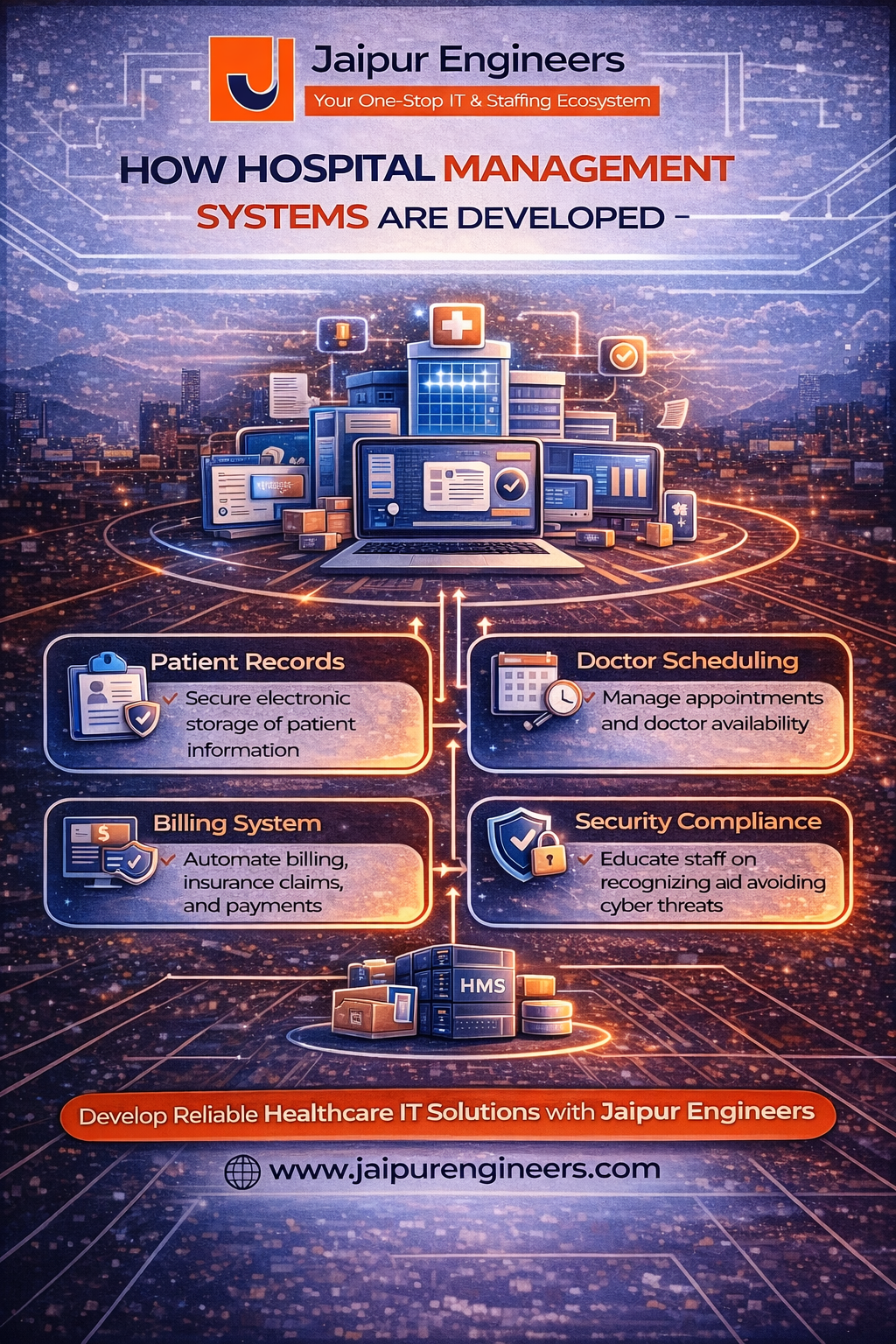
1. Patient Records Management
The patient records module is the core of any hospital software system.
It includes:
- Patient registration details
- Medical history
- Lab reports
- Prescriptions
- Treatment records
Electronic Health Records (EHR) systems store this information securely in a centralized database.
Proper database design ensures quick retrieval and data consistency.
2. Doctor Scheduling System
Doctor scheduling ensures smooth appointment management.
Features include:
- Appointment booking system
- Calendar management
- Time slot allocation
- Automated reminders
- Emergency scheduling
This module reduces waiting time and improves operational efficiency.
3. Billing and Payment System
The billing module handles financial transactions.
It includes:
- Invoice generation
- Insurance claim processing
- Payment tracking
- Integration with accounting systems
Accuracy in billing is critical to avoid financial discrepancies.
4. Security and Compliance
Healthcare data is highly sensitive and must follow strict compliance standards.
Security measures include:
- Role-based access control
- Data encryption
- Secure authentication
- Audit logs
- Regular backups
Healthcare IT solutions must comply with data protection regulations to safeguard patient privacy.
Technical Architecture Overview
A typical hospital management system includes:
- Frontend dashboard for hospital staff
- Backend server for business logic
- Centralized secure database
- API integrations (labs, pharmacies, insurance)
- Cloud or on-premise deployment
Scalability is important for large hospitals handling thousands of patients daily.
Conclusion
Hospital software systems are complex enterprise applications designed to manage healthcare operations efficiently and securely.
From patient records and doctor scheduling to billing and security compliance, every module plays a critical role.
As healthcare continues to digitize, demand for healthcare IT solutions and skilled software developers will continue to grow.
For students and developers, understanding hospital management system architecture provides strong opportunities in the healthcare technology sector.