Introduction
Many startups fail not because of poor technology, but because they build products that the market does not need. Before investing time and money into full-scale development, validating a tech idea is critical.
In this blog, we explore a practical MVP development guide, including market research, wireframing, prototype development, and testing with early users. This structured approach helps founders reduce risk and build products that solve real problems.
Why Tech Idea Validation Is Important
Building a complete product without validation can lead to:
- Wasted development cost
- Low user adoption
- Poor product-market fit
- Delayed launch timelines
Startup tech validation ensures that there is genuine demand before heavy investment.
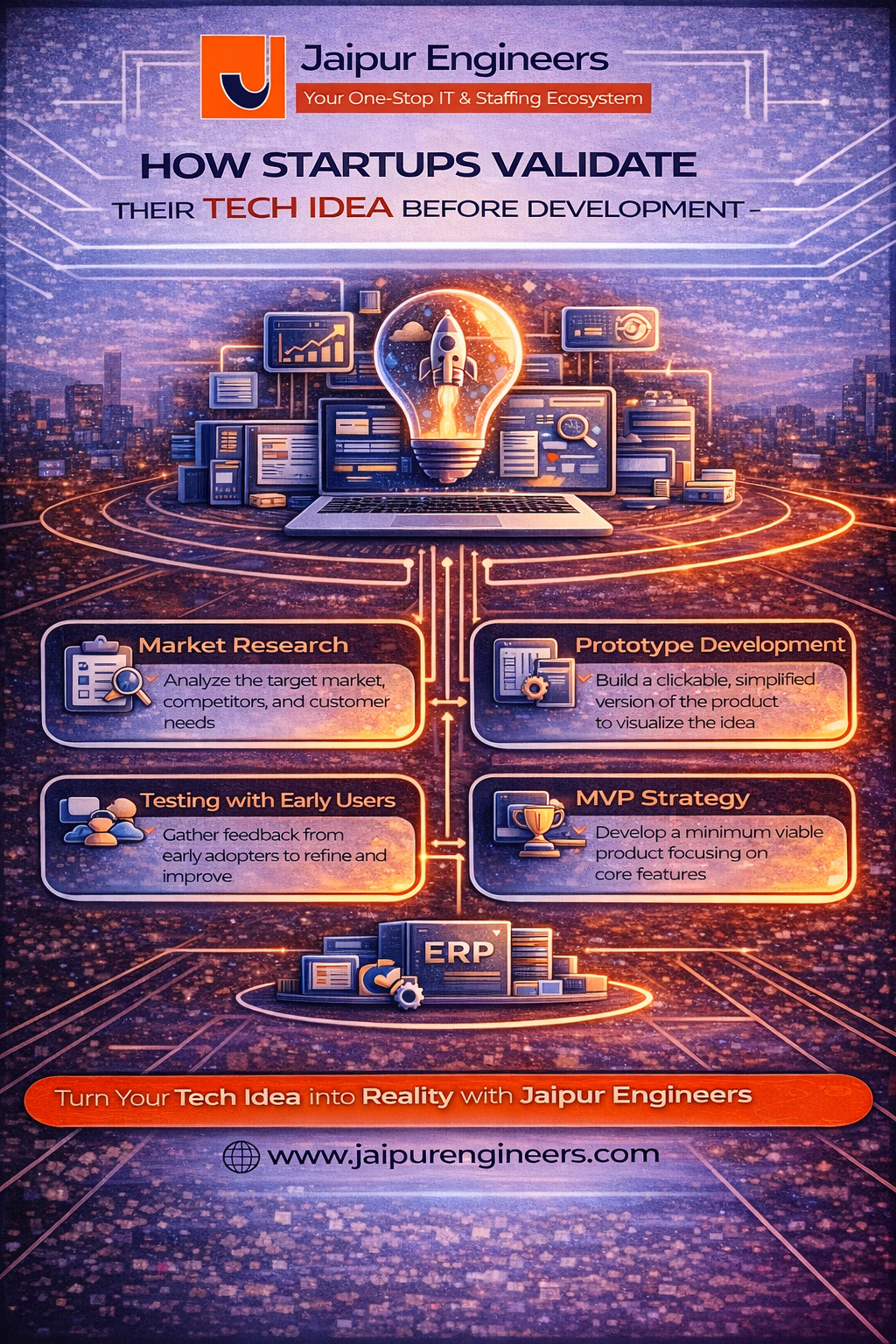
1. Market Research
The first step in startup tech validation is understanding the market.
This includes:
- Identifying target audience
- Studying competitors
- Analyzing existing solutions
- Understanding pricing models
- Finding market gaps
Market research helps determine whether the idea solves a real and urgent problem.
2. Wireframing
Wireframing is the visual blueprint of the product.
It focuses on:
- Layout structure
- User flow
- Navigation logic
- Core feature placement
Wireframes do not require full coding. They help founders visualize how users will interact with the system.
This step ensures clarity before development begins.
3. Prototype Development
After wireframing, the next step in the MVP development guide is building a prototype.
A prototype:
- Includes core features only
- Demonstrates the main value proposition
- Avoids unnecessary complexity
- Can be clickable or partially functional
The goal is to create a Minimum Viable Product (MVP) that solves one primary problem effectively.
4. Testing with Early Users
Early user feedback is one of the most important steps in startup tech validation.
Testing includes:
- Sharing MVP with a limited audience
- Collecting feedback
- Identifying usability issues
- Measuring engagement
- Tracking retention
Feedback helps improve the product before scaling.
5. Iteration and Improvement
Validation is not a one-time activity.
Startups must:
- Analyze feedback
- Improve features
- Fix technical issues
- Refine user experience
- Re-test after improvements
Continuous iteration leads to stronger product-market fit.
Technical Perspective for Developers
From a development standpoint, validation involves:
- Building scalable architecture from the start
- Keeping code modular
- Using cloud-based deployment for flexibility
- Monitoring performance metrics
Developers should focus on flexibility rather than perfection in early stages.
Conclusion
Validating a tech idea before full development is essential for startup success. Through market research, wireframing, prototype development, and early user testing, founders can minimize risk and build products that users truly need.
Following a structured MVP development guide ensures efficient resource usage and faster time-to-market.
For students and aspiring entrepreneurs, understanding startup tech validation provides valuable insight into how successful digital products are built.