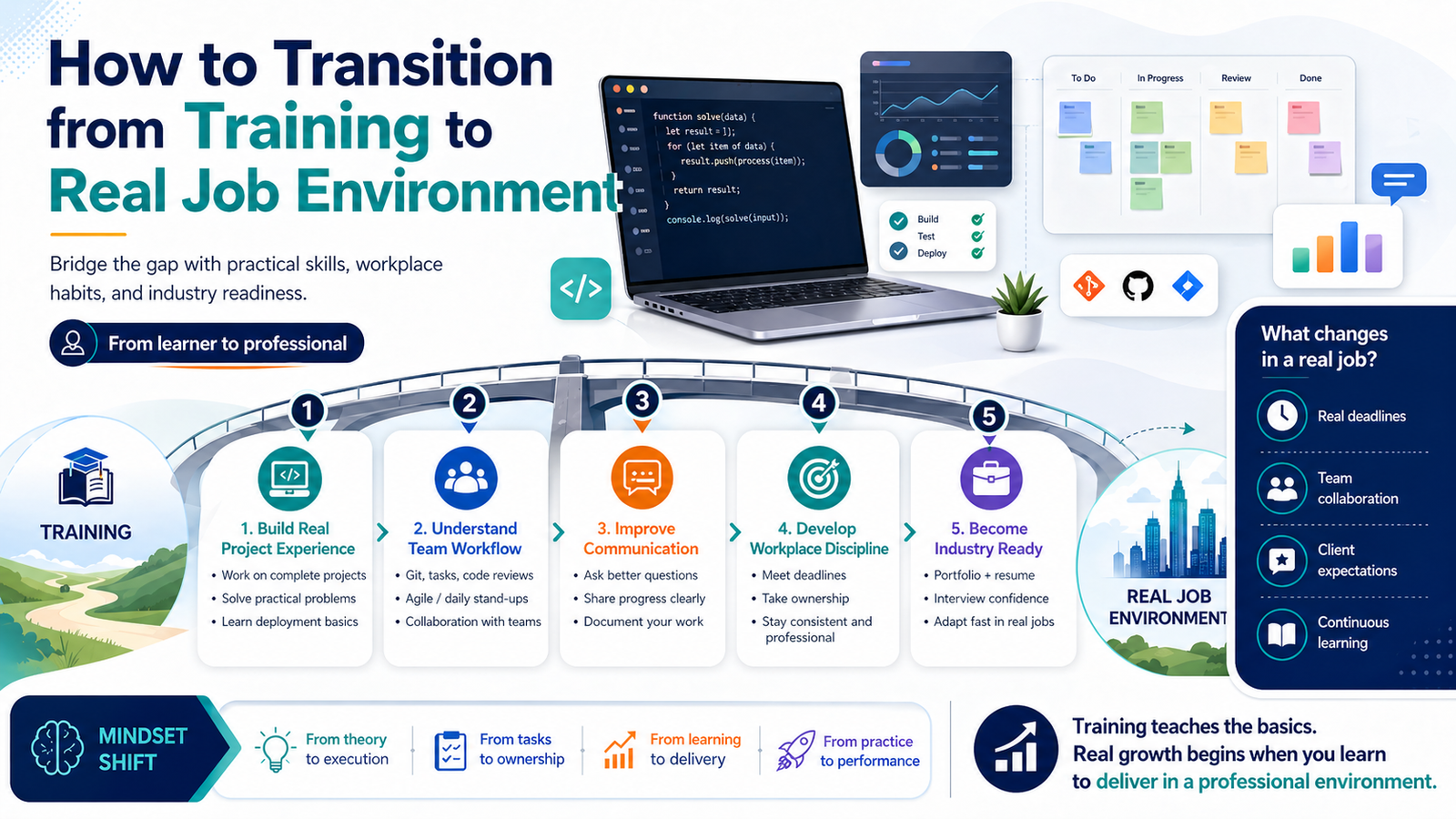
Introduction: The Biggest Gap Students Face
Many students complete courses or training programs but still struggle when they enter their first job.
Why?
Because there is a gap between learning and real industry work.
Understanding this gap — and learning how to bridge it — is the key to becoming truly job-ready.
Training vs Real Job: The Real Difference
In Training:
- Structured learning
- Small projects
- Guided coding
- No strict deadlines
In Real Job:
- Large codebases
- Real users and clients
- Strict deadlines
- Team collaboration
The shift can feel overwhelming if you are not prepared.
1️⃣ Start Thinking Like a Developer
In training, you follow instructions.
In real jobs, you are expected to:
- Solve problems independently
- Understand requirements
- Suggest solutions
Shift your mindset from “learning” to “building”.
2️⃣ Work on Real-World Projects
Before entering a job, ensure you have:
- Full stack projects
- Real use-case applications
- Deployment experience
Projects should not be basic — they should simulate real applications.
3️⃣ Learn to Read Existing Code
In companies, you rarely start from scratch.
You will work on existing projects.
Practice:
- Reading code written by others
- Understanding project structure
- Debugging existing features
This is a critical industry skill.
4️⃣ Get Comfortable with Debugging
In training, errors are simple.
In real jobs, bugs can be complex.
You must:
- Analyze issues
- Use debugging tools
- Fix problems efficiently
Debugging is one of the most important skills.
5️⃣ Understand Team Workflow
Real companies work in teams.
Learn:
- Git & GitHub workflow
- Code reviews
- Task tracking tools
- Agile development basics
Collaboration is as important as coding.
6️⃣ Improve Communication Skills
You must be able to:
- Explain your code
- Ask questions clearly
- Communicate with team members
Good communication speeds up your growth.
7️⃣ Prepare for Deadlines & Pressure
In real jobs:
- Tasks have deadlines
- Clients expect results
You need:
- Time management
- Focus
- Consistency
8️⃣ Learn Industry Tools
Before joining a job, be familiar with:
- Git & GitHub
- Deployment platforms
- Debugging tools
- Project management tools
This reduces your learning curve in the company.
9️⃣ Do Internships or Live Training
Internships are the best bridge between training and job.
They provide:
- Real-world exposure
- Team experience
- Practical learning
Even a 45–90 day internship can make a huge difference.
Common Mistakes to Avoid
❌ Thinking training is enough
❌ Avoiding complex projects
❌ Not learning teamwork
❌ Ignoring debugging skills
Final Conclusion
The gap between training and job is real — but it can be bridged.
If you:
✔ Build real projects
✔ Learn debugging
✔ Understand team workflow
✔ Practice consistently
You can transition smoothly into the IT industry.
Training teaches you how to code.
Real jobs teach you how to build systems.
Prepare for both — and you will succeed.