Introduction
The internet is evolving again. From static websites to social media platforms and now to decentralized applications, the digital world has transformed rapidly. Understanding Web3 vs Web2 difference is essential for developers, students, and tech professionals who want to stay ahead in the industry.
In this blog, we explain Web3 explained in simple terms, the concept of decentralization, smart contracts basics, risks and opportunities, and whether students should learn Web3.
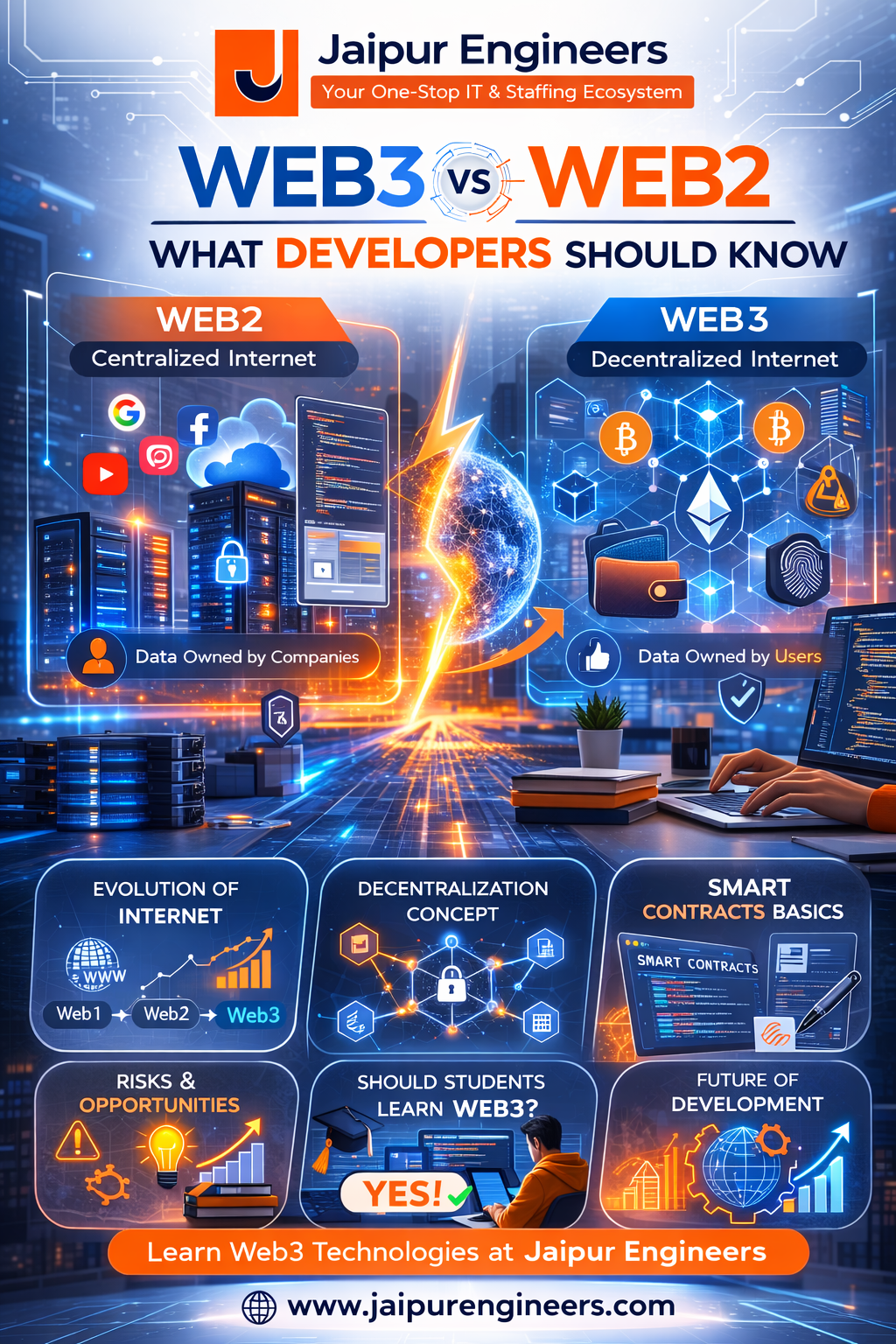
Evolution of the Internet
Web1 – Read-Only Era
The early internet (1990s) was mostly static. Users could read information but had limited interaction.
Web2 – Read & Write Era
Web2 introduced interaction. Platforms like social media, e-commerce, and SaaS products allowed users to create content. However, control remained centralized with large companies managing user data and platforms.
Web3 – Read, Write & Own Era
Web3 focuses on decentralization and digital ownership. Instead of centralized servers, applications run on blockchain networks. Users have more control over their data and digital assets.
This shift defines the Web3 vs Web2 difference at its core.
Decentralization Concept
In Web2, data is stored on centralized servers controlled by companies.
In Web3, data is distributed across blockchain networks.
Key Differences:
- Web2: Central authority controls data
- Web3: Distributed network controls data
- Web2: Platform owns user data
- Web3: Users control digital identity and assets
Decentralization reduces dependency on single entities and increases transparency. However, it also introduces technical complexity.
Smart Contracts Basics
Smart contracts are self-executing programs stored on a blockchain. They automatically enforce rules when predefined conditions are met.
For example:
- Automatic payment release after service completion
- Digital asset transfer without intermediaries
- Decentralized finance (DeFi) transactions
Smart contracts remove middlemen and increase automation. Developers working in Web3 must understand blockchain logic, gas fees, and contract security.
Risks & Opportunities in Web3
Opportunities:
- Growth of decentralized applications (dApps)
- New startup ecosystem (Web3, DeFi, NFTs)
- Global remote job opportunities
- Early mover advantage in an emerging field
Risks:
- Regulatory uncertainty
- Market volatility
- Security vulnerabilities in smart contracts
- Scalability challenges
Web3 is still evolving. It offers innovation but requires caution and strong technical knowledge.
Should Students Learn Web3?
The answer depends on career goals.
Students should learn Web3 if they:
- Have strong programming fundamentals
- Understand data structures and system design
- Are interested in blockchain and decentralized systems
- Want to explore emerging tech opportunities
However, Web3 should not replace core programming skills. A strong foundation in backend development, databases, APIs, and security is essential before specializing.
Learning Web3 as an additional skill can create competitive advantage in the coming years.
Conclusion
The Web3 vs Web2 difference represents a shift from centralized control to decentralized ownership. While Web2 continues to dominate mainstream applications, Web3 introduces new possibilities for innovation.
For developers, Web3 explained simply means understanding blockchain-based systems, smart contracts, and decentralized applications.
The future will likely combine both Web2 and Web3 models. Developers who understand both ecosystems will have better career opportunities.
Focus on fundamentals first. Then explore Web3 strategically.
That is the smart way to prepare for the future of the internet.