Introduction
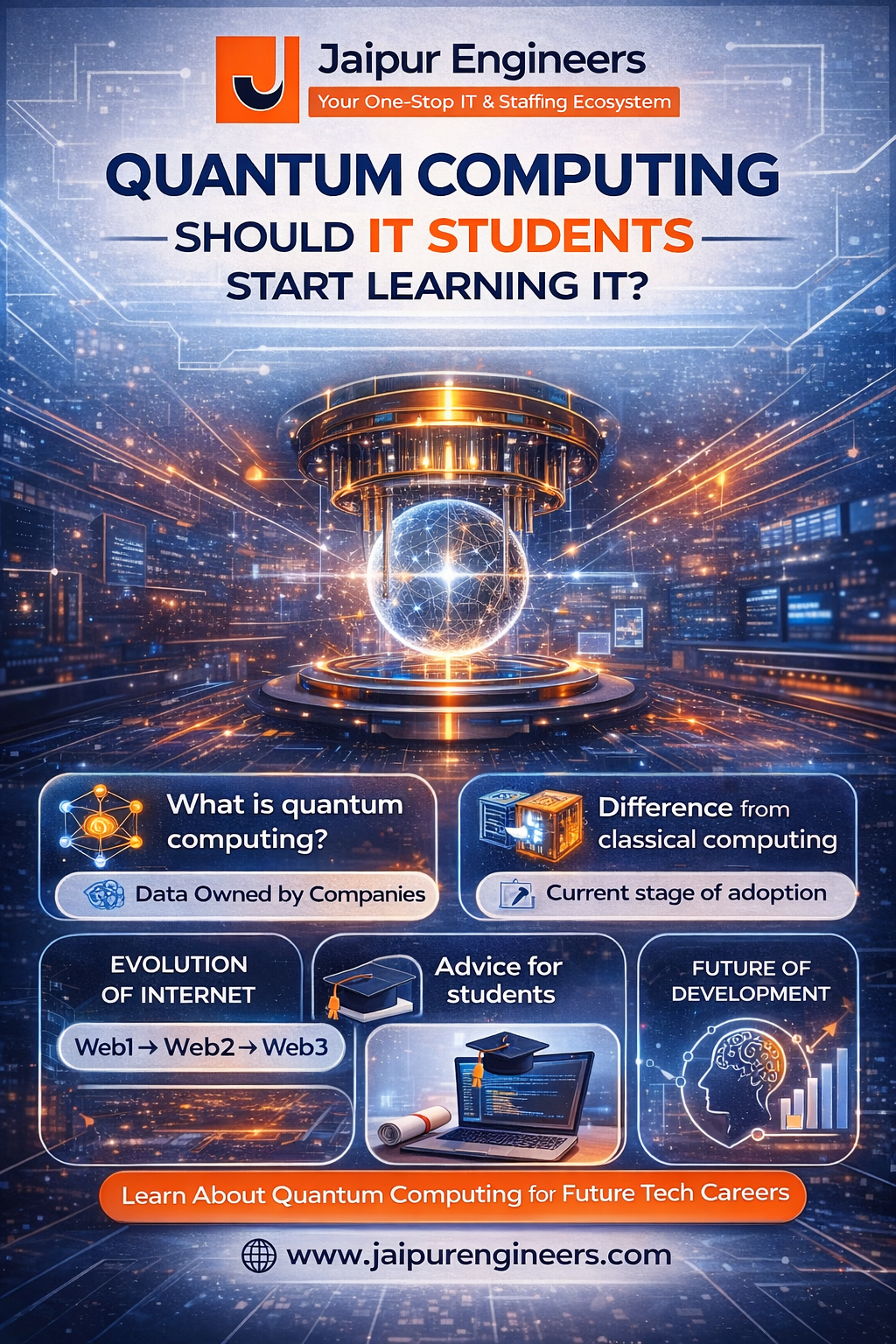
Quantum computing is often described as the next big revolution in technology. With increasing discussions around advanced research, artificial intelligence, and complex simulations, many students are asking an important question: Should IT students start learning quantum computing now?
In this blog, we explore quantum computing basics, how it differs from classical computing, its current stage of adoption, a realistic learning path, and practical advice for students planning future tech careers.
What Is Quantum Computing?
Quantum computing is a new computing paradigm based on the principles of quantum mechanics. Unlike traditional computers that use bits (0 or 1), quantum computers use qubits.
Qubits can exist in multiple states simultaneously due to concepts like:
- Superposition
- Entanglement
- Quantum interference
This allows quantum computers to process complex calculations much faster than classical systems for certain types of problems.
Quantum computing is especially useful in:
- Cryptography
- Drug discovery
- Optimization problems
- Climate modeling
- Advanced scientific simulations
Difference from Classical Computing
Understanding the difference between classical and quantum computing is essential.
Classical Computing:
- Uses bits (0 or 1)
- Sequential and logical processing
- Reliable for general-purpose applications
- Powers current software systems
Quantum Computing:
- Uses qubits (0 and 1 simultaneously)
- Parallel probability-based computation
- Specialized for complex mathematical problems
- Still experimental and research-focused
Quantum computers are not replacements for classical computers. Instead, they are designed for solving highly complex computational problems that classical systems struggle with.
Current Stage of Adoption
Quantum computing is still in its early development phase.
Current Reality:
- Mostly research and experimental use
- Limited commercial applications
- High hardware cost
- Strong involvement from large technology companies and research institutions
Although adoption is growing, quantum computing is not yet mainstream in software development.
Between now and 2030, we may see gradual enterprise integration, but classical computing will continue to dominate regular IT jobs.
Realistic Learning Path for Students
Students should approach quantum computing strategically.
Step 1: Build Strong Foundations
- Master programming (C, C++, Python, Java)
- Learn data structures and algorithms
- Understand linear algebra and probability
- Study computer architecture basics
Step 2: Learn Quantum Computing Basics
- Introduction to quantum mechanics concepts
- Qubit theory
- Quantum gates and circuits
- Basic quantum algorithms
Step 3: Explore Practical Tools
- Quantum programming frameworks
- Simulators for quantum circuits
- Research-based projects
Quantum computing requires strong mathematical and programming skills. Without fundamentals, advanced topics become very difficult.
Advice for IT Students
Should IT students start learning quantum computing?
Yes, but with realistic expectations.
If you are:
- Strong in mathematics
- Interested in research
- Curious about advanced technologies
- Planning long-term future tech careers
Then quantum computing can be a great specialization.
However, do not skip core software engineering skills. Most IT jobs in the next 5–10 years will still require strong knowledge of backend systems, cloud computing, AI, cybersecurity, and full stack development.
Quantum computing should be treated as an advanced specialization, not a replacement for core programming.
Conclusion
Quantum computing basics are important for understanding the future direction of technology. It represents one of the most exciting areas in future tech careers.
However, it is still emerging and research-driven. Students should first master classical computing, system design, and programming fundamentals.
The smartest strategy is:
Build strong foundations.
Then explore advanced technologies like quantum computing.
That balanced approach will prepare you for both present opportunities and future innovation.