Introduction
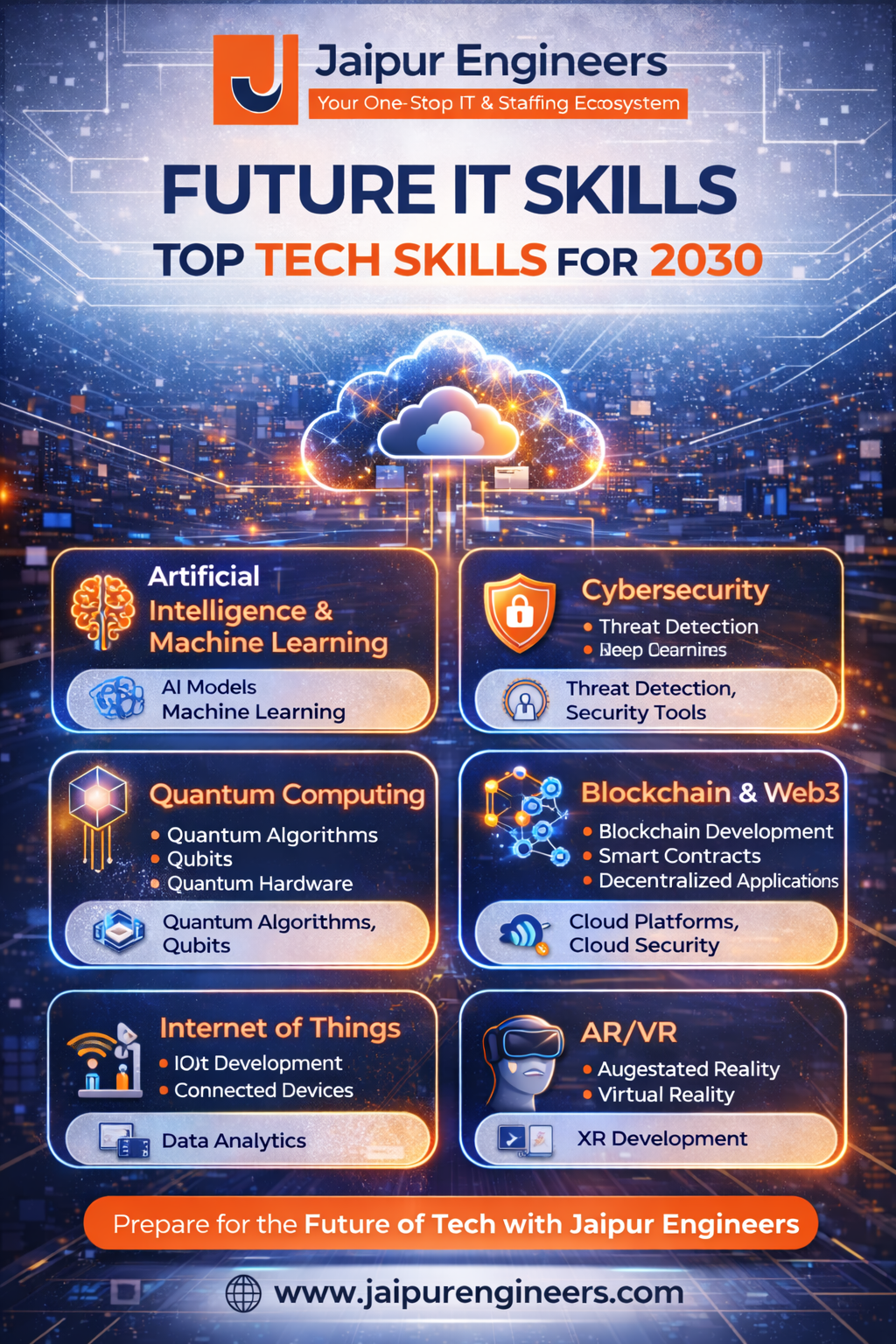
Technology is evolving at an exponential pace. While tools and frameworks change every few years, certain skills continue to remain valuable across decades. As we look ahead, understanding Future IT skills and identifying the Top tech skills 2030 will help students and professionals prepare strategically.
This blog explores the most valuable tech skills after 2030, including AI integration, cybersecurity, system design, cloud & DevOps, data engineering, and why foundational knowledge remains permanent.
AI Integration Skills
Artificial Intelligence will not replace software engineers — it will enhance them.
After 2030, the real value will lie in engineers who can:
- Integrate AI models into applications
- Customize AI solutions for business problems
- Optimize AI system performance
- Combine AI with backend and frontend systems
AI will become a layer inside almost every product. Developers who understand how to integrate AI APIs, manage data pipelines, and deploy intelligent systems will stay ahead.
AI usage is temporary.
AI integration expertise is permanent.
Cybersecurity Expertise
As digital infrastructure expands, cybersecurity becomes critical.
Future IT skills must include:
- Secure coding practices
- Network security fundamentals
- Cloud security architecture
- Ethical hacking basics
- Identity and access management
With increasing cyber threats, companies will prioritize engineers who build secure systems from the beginning.
Security is no longer optional.
It is a core engineering responsibility.
System Design Mastery
System design is one of the Top tech skills 2030.
Modern applications must handle:
- Millions of users
- High availability requirements
- Real-time data processing
- Scalable cloud infrastructure
Engineers who understand:
- Distributed systems
- Database optimization
- Caching strategies
- Load balancing
- API architecture
Will always be in demand.
Tools change.
System thinking remains.
Cloud & DevOps Capabilities
Cloud computing will continue to dominate global infrastructure.
Key skills after 2030:
- Cloud-native development
- CI/CD automation
- Infrastructure as Code
- Containerization concepts
- Monitoring and observability
DevOps is no longer a separate role. Developers are expected to understand deployment pipelines and infrastructure basics.
Cloud & DevOps knowledge will be foundational for modern software engineering.
Data Engineering & Data Infrastructure
Data is the backbone of AI and digital transformation.
High-value skills include:
- Data pipeline architecture
- Big data processing
- Real-time streaming systems
- Data modeling
- ETL optimization
Organizations need engineers who can manage and transform large-scale data efficiently.
Without structured data systems, AI and analytics cannot function effectively.
Why Foundational Knowledge Is Permanent
While frameworks and programming languages evolve, core knowledge remains timeless.
Permanent skills include:
- Data structures and algorithms
- Operating system basics
- Networking fundamentals
- Database concepts
- Problem-solving ability
These foundations allow engineers to adapt to any new technology.
The biggest mistake students make is chasing trends without building fundamentals.
Top tech skills 2030 will evolve.
Strong fundamentals will not.
Conclusion
The future after 2030 will reward engineers who combine:
- AI integration expertise
- Cybersecurity awareness
- Strong system design skills
- Cloud & DevOps capabilities
- Data engineering knowledge
However, the ultimate competitive advantage will belong to those with deep foundational understanding.
Technology changes.
Principles remain.
If you want long-term success in technology, focus on mastering Future IT skills while building strong fundamentals that never expire.