Introduction
Cloud computing has already transformed how software is built and deployed. Now, the next evolution is cloud-native development. Organizations are moving beyond traditional hosting models and adopting architectures designed specifically for the cloud.
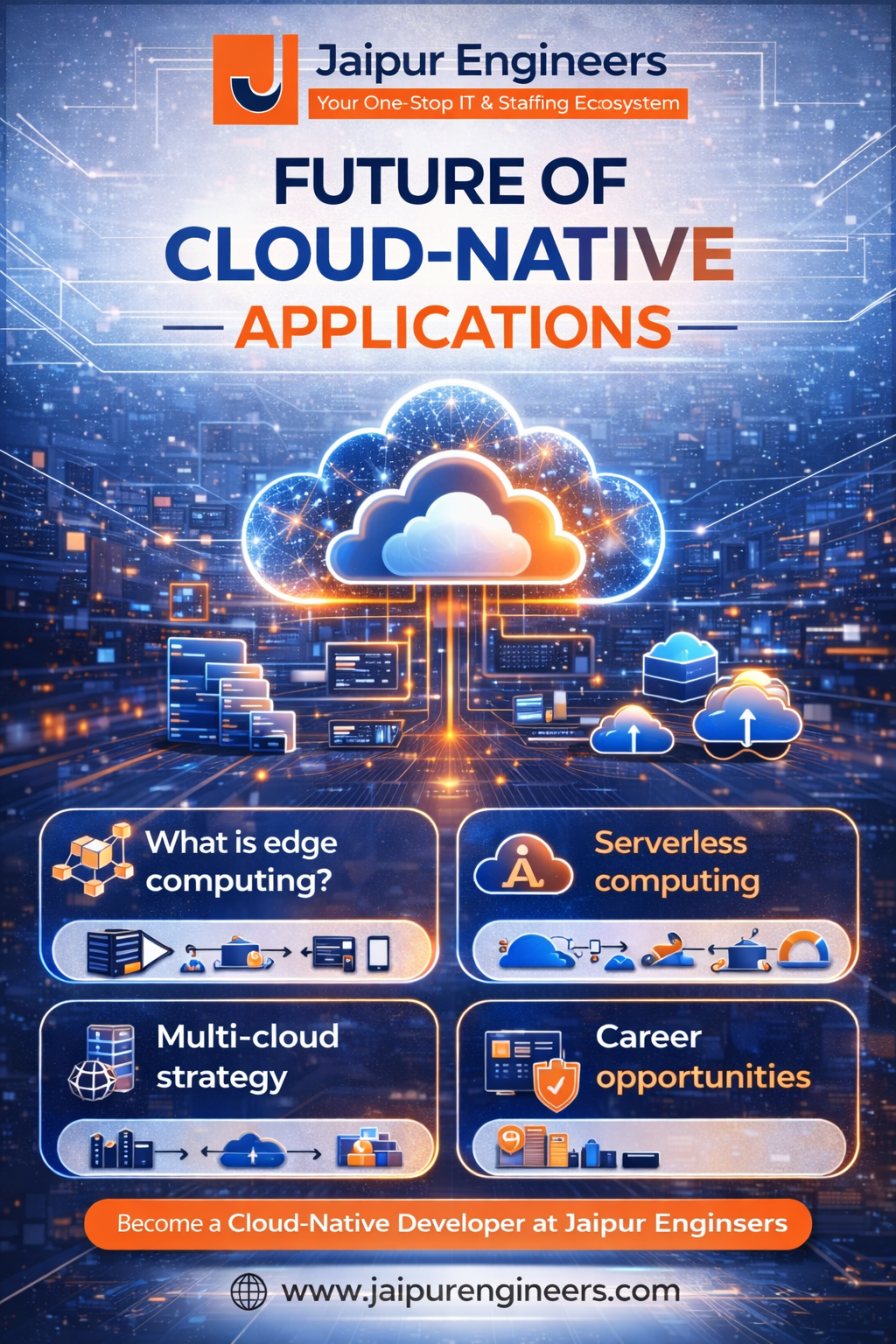
In this blog, we explore the future of cloud computing through cloud-native development, containers, microservices, serverless computing, multi-cloud strategies, and emerging career opportunities.
What Is Cloud-Native Development?
Cloud-native development is an approach to building applications that fully leverage cloud environments. Instead of simply hosting applications on the cloud, cloud-native systems are designed for scalability, flexibility, and resilience from the beginning.
Key principles include:
- Microservices architecture
- Containerization
- Continuous integration and deployment (CI/CD)
- Automation and orchestration
- Resilience and scalability
Cloud-native applications are modular, scalable, and easier to maintain compared to traditional monolithic systems.
Containers & Microservices
Containers and microservices are the foundation of cloud-native development.
Containers
Containers package applications and their dependencies together, ensuring consistency across environments. They allow applications to run smoothly across development, testing, and production.
Microservices
Instead of building one large application, microservices break systems into smaller independent services. Each service handles a specific function and communicates via APIs.
Benefits:
- Independent scaling
- Faster development cycles
- Easier maintenance
- Improved fault isolation
This modular approach is shaping the future of cloud computing.
Serverless Computing
Serverless computing allows developers to run code without managing servers. Cloud providers automatically handle infrastructure, scaling, and maintenance.
Advantages:
- Reduced operational overhead
- Pay-per-use cost model
- Automatic scaling
- Faster deployment
Serverless is ideal for event-driven applications, APIs, and real-time systems.
As businesses seek efficiency and speed, serverless adoption is expected to grow rapidly.
Multi-Cloud Strategy
Modern enterprises are adopting multi-cloud strategies instead of relying on a single cloud provider.
Why Multi-Cloud?
- Avoid vendor lock-in
- Increase reliability
- Improve performance across regions
- Enhance disaster recovery
Cloud-native applications are designed to work seamlessly across multiple cloud environments, making multi-cloud strategy a critical part of future infrastructure planning.
Career Opportunities in Cloud-Native Development
The future of cloud computing is creating strong demand for skilled professionals.
High-demand roles include:
- Cloud Engineers
- DevOps Engineers
- Site Reliability Engineers (SRE)
- Cloud Architects
- Kubernetes Administrators
- Backend Developers with cloud expertise
Skills required:
- Strong programming fundamentals
- Understanding of distributed systems
- Knowledge of CI/CD pipelines
- Infrastructure as Code (IaC)
- Container orchestration concepts
Professionals who understand cloud-native development will have strong career growth opportunities between 2026 and 2030.
Conclusion
The future of cloud computing is cloud-native. Containers, microservices, serverless computing, and multi-cloud strategies are transforming how modern applications are built.
For students and IT professionals, learning cloud-native development is no longer optional. It is becoming a core skill for modern software engineering.
By mastering cloud fundamentals along with system design and backend architecture, you can position yourself strongly in the evolving technology landscape.
The future belongs to engineers who build for the cloud from day one.