Software development is one of the fastest-growing career fields in the world, and programming languages form the backbone of every software application. Among the many programming languages available today, Java has remained one of the most reliable, secure, and widely adopted technologies for more than two decades.
Before learning advanced frameworks such as Spring Boot, Hibernate, Microservices, or Java Full Stack Development, every aspiring developer should first master Core Java. It introduces the essential programming concepts required to build high-quality software and provides the knowledge needed to understand enterprise-level application development.
Whether you are a student beginning your coding journey or a professional planning to switch careers, learning Core Java helps develop logical thinking, problem-solving abilities, object-oriented programming skills, and coding best practices.
In this guide, we will explore why Core Java is considered the foundation of software development, how it prepares you for advanced technologies, and why it remains one of the best programming languages to learn in 2026.
What is Core Java?
Core Java is the basic version of the Java programming language that focuses on the fundamental concepts required to build standalone applications.
It covers topics such as:
- Variables
- Data Types
- Operators
- Control Statements
- Loops
- Methods
- Arrays
- Strings
- Object-Oriented Programming
- Exception Handling
- Collections Framework
- Multithreading
- File Handling
- JDBC Basics
These concepts serve as the building blocks for advanced Java technologies and enterprise software development.
Why is Core Java Called the Foundation of Software Development?
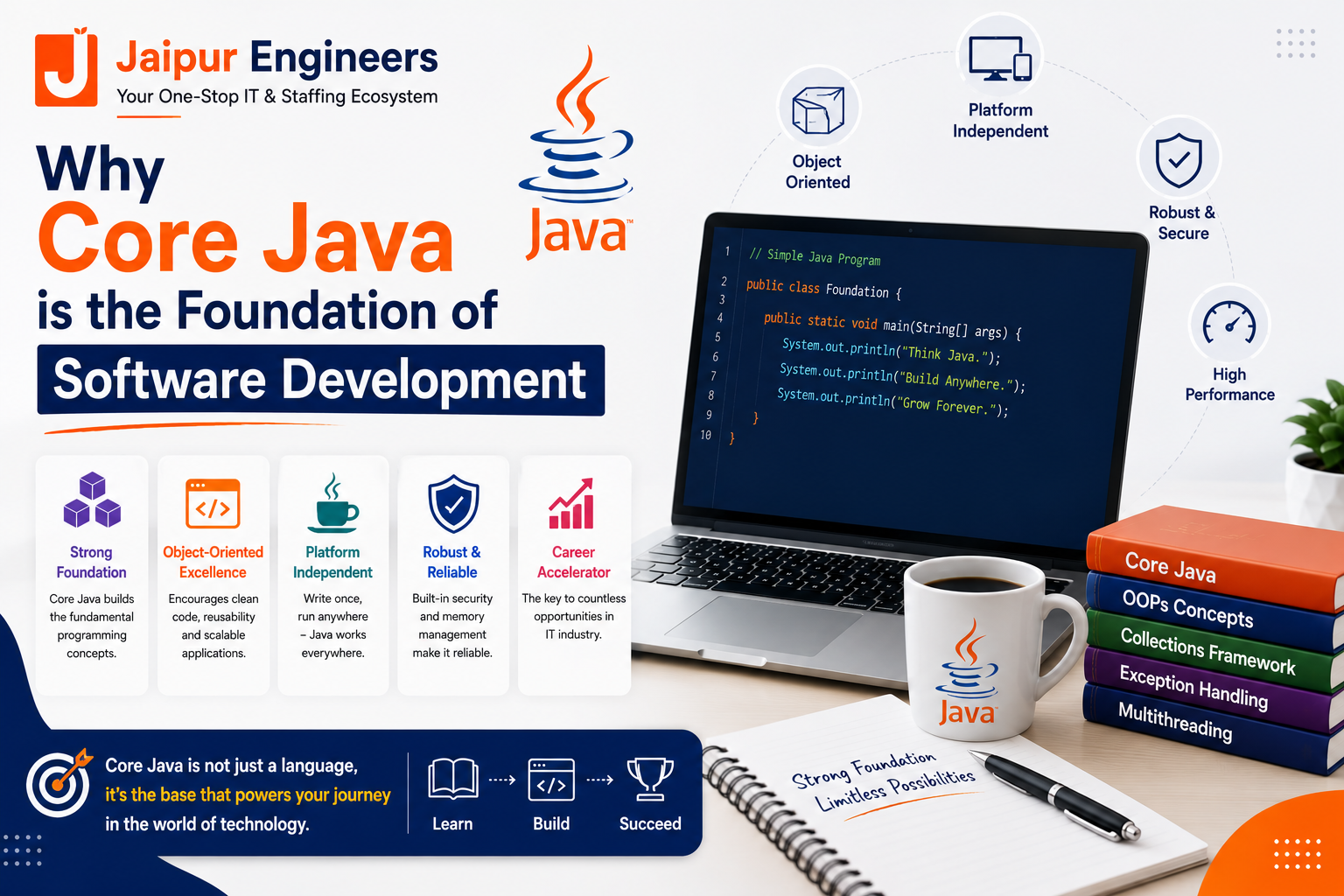
Just as a strong foundation supports a building, Core Java provides the essential programming knowledge required to build reliable and scalable software applications.
Without understanding Core Java, learning advanced Java frameworks becomes difficult.
It teaches developers:
- Programming Logic
- Problem Solving
- Object-Oriented Programming
- Code Reusability
- Error Handling
- Memory Management
- Best Coding Practices
These skills are required in almost every software development role.
1. Builds Strong Programming Fundamentals
Every successful software developer begins by understanding programming fundamentals.
Core Java teaches:
- Variables
- Data Types
- Operators
- Decision Making
- Loops
- Methods
- Arrays
These concepts improve logical thinking and problem-solving abilities, which are essential for writing efficient software.
2. Introduces Object-Oriented Programming (OOP)
Object-Oriented Programming is one of the most important concepts in software engineering.
Core Java introduces:
- Encapsulation
- Inheritance
- Polymorphism
- Abstraction
Most modern software applications are built using OOP principles because they improve code organization, maintainability, and scalability.
3. Improves Logical Thinking
Programming is not just about writing code—it is about solving problems.
Learning Core Java helps students:
- Analyze Problems
- Write Efficient Algorithms
- Improve Debugging Skills
- Develop Logical Thinking
- Build Computational Skills
These abilities are valuable in both technical interviews and real-world software development.
4. Teaches Industry Coding Standards
Professional software development requires writing clean, maintainable, and reusable code.
Core Java introduces best practices such as:
- Proper Naming Conventions
- Code Organization
- Modular Programming
- Exception Handling
- Reusable Methods
These standards help developers work effectively in professional software teams.
5. Forms the Base for Advanced Java
Every advanced Java technology depends on Core Java concepts.
After mastering Core Java, students can confidently learn:
- Advanced Java
- JDBC
- Servlets
- JSP
- Hibernate
- Spring Framework
- Spring Boot
- REST APIs
- Microservices
This progression makes Core Java one of the most valuable programming languages for beginners.
6. Used in Enterprise Software Development
Java is trusted by organizations around the world because of its security, scalability, and performance.
Industries using Java include:
- Banking
- Healthcare
- Government
- Retail
- Telecommunications
- Education
- Manufacturing
- Cloud Computing
Because of its widespread adoption, learning Core Java creates long-term career opportunities.
7. Platform Independent Programming
One of Java’s biggest strengths is its platform independence.
Java follows the principle:
Write Once, Run Anywhere (WORA)
This means Java applications can run on Windows, Linux, macOS, and other operating systems without changing the source code.
8. Prepares You for Software Engineering Careers
Core Java provides the technical foundation required for careers such as:
- Java Developer
- Software Engineer
- Backend Developer
- Android Developer
- Full Stack Java Developer
- Application Developer
Strong Core Java knowledge also improves performance in coding interviews and technical assessments.
9. Helps You Understand Data Structures and Algorithms
After learning Core Java, students can easily understand Data Structures and Algorithms (DSA), which are essential for software engineering interviews and efficient application development.
Some commonly used data structures include:
- Arrays
- Linked Lists
- Stacks
- Queues
- Trees
- HashMaps
Combining Core Java with DSA significantly improves problem-solving skills and interview performance.
10. Encourages Code Reusability
One of the biggest advantages of Core Java is its support for reusable code through Object-Oriented Programming principles.
Developers can:
- Reuse Classes
- Create Utility Methods
- Extend Existing Classes
- Reduce Duplicate Code
This leads to faster development, easier maintenance, and improved software quality.
11. Supports Scalable Software Development
Modern software applications often serve thousands or even millions of users. Core Java introduces concepts that help developers build scalable and maintainable applications.
These include:
- Exception Handling
- Collections Framework
- Multithreading
- File Handling
- Memory Management
These concepts are widely used in enterprise-level software development.
12. Opens the Door to Modern Technologies
Learning Core Java is the first step toward mastering advanced technologies that are highly valued in the IT industry.
The recommended learning path is:
- Core Java
- Advanced Java
- JDBC
- Servlets
- JSP
- Hibernate
- Spring Framework
- Spring Boot
- REST APIs
- Microservices
- Java Full Stack Development
Each stage builds on the concepts learned in Core Java.
Career Opportunities After Learning Core Java
A strong foundation in Core Java allows learners to pursue various software development roles.
Popular career opportunities include:
- Java Developer
- Software Engineer
- Backend Developer
- Application Developer
- Android Developer
- Java Full Stack Developer
- QA Automation Engineer
- Technical Consultant
- Software Programmer
- Junior Software Engineer
As your experience grows, you can advance to Technical Lead, Solution Architect, or Engineering Manager positions.
Java Developer Salary in India (2026)
| Experience | Average Salary |
|---|---|
| Fresher | ₹3.5–6 LPA |
| 2–4 Years | ₹6–12 LPA |
| 5–8 Years | ₹12–22 LPA |
| Senior Java Developer | ₹22–40+ LPA |
| Solution Architect | ₹40–60+ LPA |
Salary depends on technical skills, certifications, projects, company, and location.
Why Choose Jaipur Engineers?
At Jaipur Engineers, we believe practical experience is the key to becoming a successful software developer. Our Core Java training program is designed to provide students with real-world programming skills through hands-on learning and expert guidance.
Why Students Choose Jaipur Engineers
- Industry-Experienced Trainers
- Practical Live Coding Sessions
- Real-World Projects
- Updated Industry Curriculum
- Coding Assignments
- Interview Preparation
- Resume Building
- Mock Interviews
- Placement Assistance
- Flexible Batch Timings
- Course Completion Certificate
- Lifetime Learning Support
Our objective is to help students become confident, job-ready Java developers with strong programming fundamentals.
Internal Links
Include these relevant internal links naturally throughout the article:
- Home: https://jaipurengineers.com/
- Java Programming Course: https://jaipurengineers.com/java-programming-course-jaipur/
- Java Full Stack Course: https://jaipurengineers.com/java-full-stack-course-jaipur/
- Placement Assistance: https://jaipurengineers.com/placement-assistance/
- Student Placements: https://jaipurengineers.com/student-placements/
- Contact Us: https://jaipurengineers.com/contact-us/
Conclusion
Core Java is much more than just a programming language—it is the foundation upon which successful software development careers are built. It teaches the essential concepts required to write clean, efficient, and maintainable code while preparing learners for advanced Java technologies such as Spring Boot, Hibernate, REST APIs, and Full Stack Development.
By mastering Core Java, students develop logical thinking, problem-solving abilities, object-oriented programming skills, and the confidence needed to build real-world applications. Whether your goal is to become a Java Developer, Backend Developer, or Full Stack Engineer, a strong understanding of Core Java is the first and most important step.
At Jaipur Engineers, we combine expert mentorship, practical projects, interview preparation, and placement assistance to help students build successful careers in software development.
Call to Action
🚀 Build a Strong Software Development Foundation with Core Java
Join the Core Java Course at Jaipur Engineers and learn from industry experts through live coding sessions, practical projects, certification, and placement assistance.
👉 Explore the Course: https://jaipurengineers.com/java-programming-course-jaipur/
📞 Contact Us: https://jaipurengineers.com/contact-us/
Frequently Asked Questions (FAQs)
1. Why is Core Java considered the foundation of software development?
Core Java introduces programming fundamentals, Object-Oriented Programming (OOP), exception handling, collections, multithreading, and other concepts required for modern software development.
2. Is Core Java enough to become a software developer?
Core Java is the starting point. To become job-ready, you should also learn Advanced Java, Spring Boot, SQL, REST APIs, and build practical projects.
3. Can beginners learn Core Java?
Yes. Core Java is beginner-friendly and is one of the best programming languages for learning programming fundamentals.
4. What should I learn after Core Java?
Advanced Java, JDBC, Servlets, JSP, Hibernate, Spring Boot, REST APIs, SQL, Git, and Java Full Stack Development.
5. Is Java still relevant in 2026?
Yes. Java remains one of the most widely used programming languages for enterprise software, cloud applications, banking, healthcare, and backend systems.
6. What jobs can I get after learning Core Java?
You can work as a Java Developer, Software Engineer, Backend Developer, Application Developer, or QA Automation Engineer.
7. How long does it take to learn Core Java?
Most students complete Core Java in 2–3 months with regular practice.
8. Does Jaipur Engineers provide placement assistance?
Yes. Students receive placement support, mock interviews, resume-building guidance, and career counseling.
9. Is Core Java required for Spring Boot?
Yes. A strong understanding of Core Java is essential before learning Spring Boot and other advanced Java frameworks.
10. Why should I choose Jaipur Engineers?
Jaipur Engineers offers practical training, industry-experienced trainers, real-world projects, certification, interview preparation, and placement assistance.