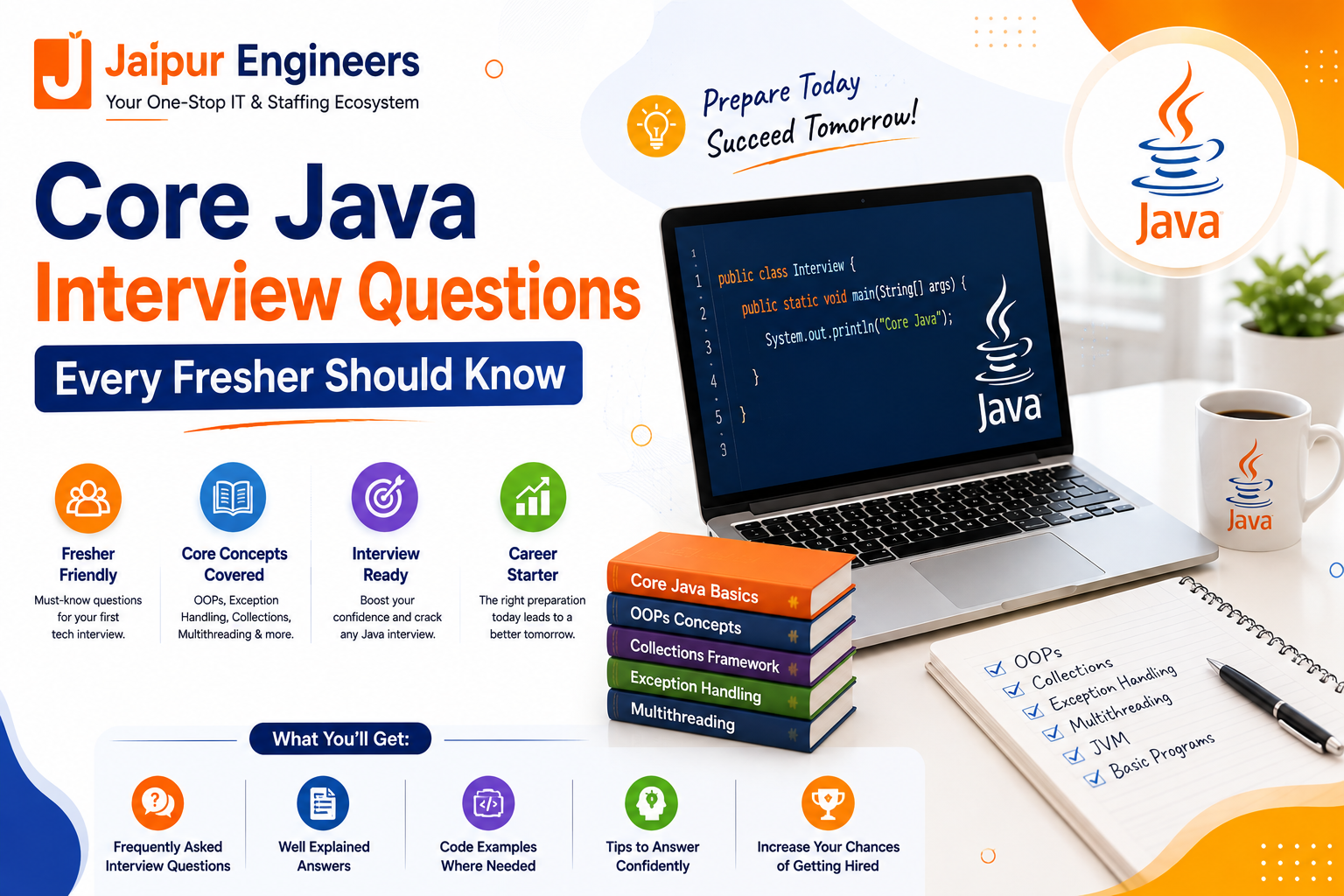
Preparing for your first Java interview can be both exciting and challenging. Most companies hiring freshers expect candidates to have a solid understanding of Core Java because it forms the foundation of Java application development. Even if the company uses advanced technologies like Spring Boot or Microservices, interviewers usually begin by assessing your knowledge of Java fundamentals.
Whether you’re a college student, recent graduate, or aspiring software developer, practicing common interview questions can significantly improve your confidence and increase your chances of securing your first job.
In this guide, we’ve compiled some of the most frequently asked Core Java interview questions for freshers. Each question includes a simple explanation to help beginners understand the concepts more effectively.
Why Are Core Java Interview Questions Important?
Interviewers ask Core Java questions to evaluate:
- Programming Fundamentals
- Logical Thinking
- Problem-Solving Skills
- Understanding of Object-Oriented Programming
- Coding Ability
- Knowledge of Java Syntax
- Practical Development Skills
A strong understanding of Core Java demonstrates that you are ready to learn advanced technologies and work on real-world software projects.
1. What is Java?
Answer:
Java is a high-level, object-oriented, platform-independent programming language developed by Sun Microsystems (now Oracle). It follows the principle of “Write Once, Run Anywhere (WORA)”, allowing Java applications to run on any operating system that supports the Java Virtual Machine (JVM).
2. What are the Main Features of Java?
Answer:
Some important features include:
- Platform Independent
- Object-Oriented
- Secure
- Robust
- Portable
- High Performance
- Multithreaded
- Distributed
- Dynamic
3. What is the Difference Between JDK, JRE, and JVM?
| Component | Description |
|---|---|
| JDK | Java Development Kit used for developing Java applications |
| JRE | Java Runtime Environment used to run Java applications |
| JVM | Java Virtual Machine that executes Java bytecode |
4. What is Object-Oriented Programming (OOP)?
Answer:
Object-Oriented Programming is a programming paradigm based on objects and classes.
The four main OOP principles are:
- Encapsulation
- Inheritance
- Polymorphism
- Abstraction
5. What is the Difference Between == and equals()?
Answer:
- == compares object references.
- equals() compares object values or contents.
For String comparison, equals() is generally preferred.
6. What is a Constructor?
Answer:
A constructor is a special method that is automatically called when an object is created.
Characteristics:
- Same name as the class
- No return type
- Used to initialize objects
7. What is Method Overloading?
Answer:
Method overloading allows multiple methods with the same name but different parameter lists within the same class.
It is an example of compile-time polymorphism.
8. What is Method Overriding?
Answer:
Method overriding occurs when a subclass provides its own implementation of a method already defined in the parent class.
It is an example of runtime polymorphism.
9. What is Exception Handling?
Answer:
Exception Handling is a mechanism used to handle runtime errors and prevent program crashes.
Common keywords include:
- try
- catch
- finally
- throw
- throws
10. What is the Difference Between Checked and Unchecked Exceptions?
| Checked Exception | Unchecked Exception |
|---|---|
| Checked at compile time | Checked at runtime |
| Must be handled | Optional handling |
| Example: IOException | Example: NullPointerException |
11. What is the Collections Framework?
Answer:
The Collections Framework provides classes and interfaces to store and manipulate groups of objects efficiently.
Popular collections include:
- ArrayList
- LinkedList
- HashSet
- TreeSet
- HashMap
- TreeMap
12. What is Multithreading?
Answer:
Multithreading allows a program to execute multiple tasks simultaneously, improving performance and resource utilization.
13. What is Garbage Collection?
Answer:
Garbage Collection is Java’s automatic memory management process that removes unused objects from memory.
It helps prevent memory leaks and improves application performance.
14. What is JDBC?
Answer:
JDBC (Java Database Connectivity) is an API that enables Java applications to connect with databases and perform CRUD operations.
15. Why Should Freshers Learn Core Java Thoroughly?
A strong understanding of Core Java helps freshers:
- Crack Technical Interviews
- Learn Spring Boot Faster
- Build Real Projects
- Understand Backend Development
- Improve Coding Skills
- Get Better Placement Opportunities
16. What is the Difference Between Array and ArrayList?
| Array | ArrayList |
|---|---|
| Fixed size | Dynamic size |
| Stores primitive and object types | Stores objects only (wrapper classes for primitives) |
| Faster for fixed data | Flexible and easier to use |
| Part of Java language | Part of Collections Framework |
17. What is the Difference Between HashMap and HashSet?
HashMap
- Stores key-value pairs.
- Keys must be unique.
- Allows one null key and multiple null values.
HashSet
- Stores only unique values.
- Does not store key-value pairs.
- Allows one null value.
18. What is String, StringBuffer, and StringBuilder?
| Class | Mutable | Thread Safe |
|---|---|---|
| String | No | Yes |
| StringBuffer | Yes | Yes |
| StringBuilder | Yes | No |
Use StringBuilder for better performance in single-threaded applications and StringBuffer when thread safety is required.
19. What is the Difference Between Abstract Class and Interface?
| Abstract Class | Interface |
|---|---|
| Can have constructors | Cannot have constructors |
| Can contain implemented methods | Primarily defines method contracts |
| Supports instance variables | Uses constants by default |
| A class can extend only one abstract class | A class can implement multiple interfaces |
20. What is Polymorphism?
Polymorphism allows the same method name to behave differently based on the object or parameters.
Types of polymorphism:
- Compile-Time Polymorphism (Method Overloading)
- Runtime Polymorphism (Method Overriding)
21. What is Encapsulation?
Encapsulation is the process of binding data and methods together into a single unit (class) while restricting direct access to the data using access modifiers.
Benefits:
- Data Security
- Better Code Organization
- Easier Maintenance
22. What is Inheritance?
Inheritance allows one class to acquire the properties and methods of another class.
Benefits:
- Code Reusability
- Reduced Redundancy
- Better Maintainability
23. What is Abstraction?
Abstraction hides implementation details and exposes only essential functionality to the user.
It is achieved using:
- Abstract Classes
- Interfaces
24. What are Access Modifiers in Java?
Java provides four access modifiers:
- Public – Accessible from anywhere.
- Protected – Accessible within the package and subclasses.
- Default – Accessible within the same package.
- Private – Accessible only within the same class.
25. What is the Difference Between Compile-Time and Runtime Errors?
| Compile-Time Error | Runtime Error |
|---|---|
| Found during compilation | Found while the program is running |
| Syntax mistakes | Logical or execution errors |
| Prevents compilation | Occurs after successful compilation |
Java Interview Preparation Tips
To perform well in interviews:
- Practice Java coding daily.
- Revise Object-Oriented Programming concepts.
- Understand Collections Framework.
- Learn Exception Handling thoroughly.
- Solve logical programming questions.
- Practice SQL basics.
- Understand JDBC concepts.
- Build Java mini-projects.
- Keep your GitHub profile updated.
- Participate in mock interviews.
Common Mistakes Freshers Should Avoid
Many candidates lose opportunities due to avoidable mistakes.
Avoid:
- Memorizing answers without understanding concepts.
- Ignoring coding practice.
- Weak understanding of OOP.
- Not preparing SQL basics.
- Poor communication skills.
- Lack of practical project experience.
- Incomplete resume or GitHub profile.
Frequently Asked Questions (FAQs)
1. What are the most important Core Java interview topics?
Focus on OOP concepts, Collections Framework, Exception Handling, Multithreading, Strings, Arrays, JDBC, and JVM architecture.
2. How many Core Java questions should I prepare?
Preparing 50–100 frequently asked questions with practical coding examples is a good starting point.
3. Is coding asked in Java fresher interviews?
Yes. Many companies include coding questions on arrays, strings, loops, patterns, and OOP concepts.
4. Is Core Java enough for interviews?
Core Java is essential, but learning SQL, JDBC, Git, and Spring Boot gives you a competitive advantage.
5. How can I improve my Java interview skills?
Practice coding daily, revise Java concepts, solve mock interview questions, and build projects.
6. Which Java version should I learn?
Learning modern Java versions (Java 17 or Java 21) is recommended while maintaining a strong Core Java foundation.
7. Are projects important for Java interviews?
Yes. Projects demonstrate practical knowledge and improve your resume.
8. What is the average salary for Java freshers?
Freshers generally earn between ₹3.5–6 LPA, depending on skills and company.
9. Does Jaipur Engineers provide interview preparation?
Yes. Students receive mock interviews, resume-building support, coding practice, and placement assistance.
10. Can beginners crack Java interviews?
Absolutely. With consistent practice and a solid understanding of Core Java concepts, beginners can successfully clear entry-level Java interviews.