Technology continues to evolve rapidly, but one programming language has consistently remained relevant for more than two decades—Java. Despite the emergence of newer languages and frameworks, Java continues to power enterprise software, banking systems, cloud applications, Android development, e-commerce platforms, and millions of business applications worldwide.
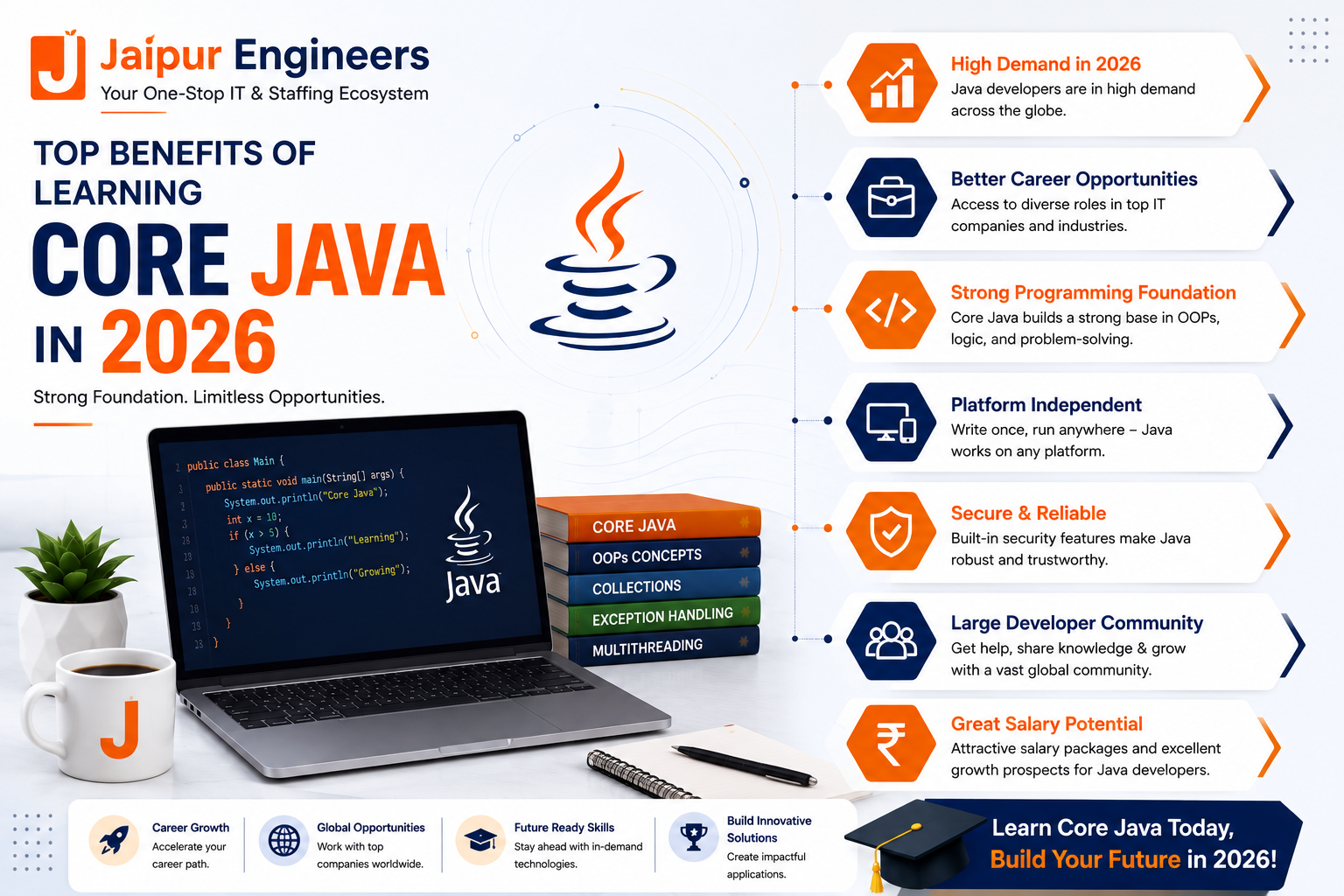
If you’re planning to build a career in software development, learning Core Java is one of the smartest decisions you can make in 2026. It provides the programming fundamentals required to understand advanced Java technologies such as Spring Boot, Hibernate, REST APIs, and Microservices. More importantly, Core Java develops logical thinking, object-oriented programming skills, and problem-solving abilities that are valuable across the software industry.
Whether you’re a student, graduate, or working professional, learning Core Java opens the door to exciting career opportunities with competitive salaries and long-term growth.
In this guide, we’ll explore the top benefits of learning Core Java in 2026, why it’s still one of the most in-demand programming languages, and how it can help you build a successful career in IT.
Why is Core Java Still Relevant in 2026?
Although many programming languages are available today, Java remains a preferred choice for enterprise software development because of its reliability, scalability, and security.
Thousands of startups, product companies, and multinational organizations continue to build and maintain Java-based applications.
Java is widely used in:
- Banking Applications
- E-commerce Platforms
- Healthcare Systems
- ERP Software
- Government Portals
- Telecom Applications
- Cloud Computing
- Android Development
- Financial Systems
- Enterprise Applications
Because of this widespread adoption, Java developers continue to be in high demand worldwide.
1. Strong Foundation for Programming
One of the biggest advantages of learning Core Java is that it builds a solid programming foundation.
Students learn important concepts such as:
- Variables
- Data Types
- Operators
- Loops
- Methods
- Arrays
- Object-Oriented Programming
- Exception Handling
- Collections
- Multithreading
These concepts are useful not only in Java but also when learning other programming languages.
2. Excellent Career Opportunities
Core Java opens doors to a wide range of software development careers.
Popular job roles include:
- Java Developer
- Software Engineer
- Backend Developer
- Full Stack Java Developer
- Android Developer
- Application Developer
- QA Automation Engineer
As organizations continue to rely on Java-based systems, skilled Java developers remain highly sought after.
3. High Salary Potential
Java developers enjoy competitive salaries due to the language’s widespread use in enterprise software.
Average salary in India (2026):
| Experience | Salary |
|---|---|
| Fresher | ₹3.5–6 LPA |
| 2–4 Years | ₹6–12 LPA |
| 5–8 Years | ₹12–22 LPA |
| Senior Developer | ₹22–40+ LPA |
Developers with expertise in Spring Boot, Microservices, and Cloud technologies can earn even higher packages.
4. Platform Independence
One of Java’s most famous features is Write Once, Run Anywhere (WORA).
Java applications can run on Windows, Linux, macOS, and other operating systems without changing the source code, making Java highly portable.
5. Object-Oriented Programming Skills
Core Java introduces Object-Oriented Programming (OOP), which is used by most modern software applications.
Students learn:
- Encapsulation
- Inheritance
- Polymorphism
- Abstraction
Understanding these principles improves code quality and makes software easier to maintain and scale.
6. Huge Community Support
Java has one of the largest developer communities in the world.
Benefits include:
- Free Learning Resources
- Documentation
- Open-Source Libraries
- Community Forums
- Tutorials
- Code Examples
Beginners can easily find solutions to programming problems and continue learning with community support.
7. Gateway to Advanced Technologies
Core Java is the starting point for several advanced technologies.
After mastering Core Java, you can learn:
- Advanced Java
- JDBC
- Hibernate
- Spring Framework
- Spring Boot
- REST APIs
- Microservices
- Java Full Stack Development
This progression allows developers to build enterprise-grade web applications and backend systems.
8. Better Problem-Solving Skills
Programming is all about solving problems.
Daily Java coding helps improve:
- Logical Thinking
- Analytical Skills
- Debugging
- Algorithm Design
- Code Optimization
These skills are valuable in software development and technical interviews.
9. Enterprise-Level Programming Language
Many of the world’s largest organizations use Java because of its stability and scalability.
Java is trusted by industries such as:
- Banking
- Insurance
- Healthcare
- Retail
- Telecommunications
- Government
- Education
Its enterprise focus ensures long-term demand for skilled Java developers.
10. Easy Transition to Full Stack Development
Learning Core Java makes it easier to become a Full Stack Developer.
The typical learning path is:
Core Java → Advanced Java → Spring Boot → REST APIs → SQL → HTML → CSS → JavaScript → React → Java Full Stack Developer
This roadmap significantly expands your career opportunities.
11. High Demand Across Industries
Java is not limited to one sector. It is used by companies of all sizes, from startups to multinational corporations. Organizations rely on Java because it is secure, scalable, and suitable for building enterprise-grade applications.
Industries hiring Java developers include:
- Information Technology
- Banking & Finance
- Healthcare
- E-commerce
- Telecommunications
- Education
- Logistics
- Government Organizations
- Manufacturing
- Cloud Computing Companies
This broad adoption ensures consistent job opportunities for Java professionals.
12. Easy to Learn for Beginners
Core Java is often recommended as one of the best programming languages for beginners because it has:
- Simple and readable syntax
- Strong documentation
- Large learning community
- Structured programming approach
- Extensive online learning resources
Students who learn Core Java can easily understand programming fundamentals and transition to other technologies.
13. Foundation for Modern Java Frameworks
Modern Java development depends heavily on frameworks such as:
- Spring Framework
- Spring Boot
- Hibernate
- Jakarta EE
- Maven
- Gradle
Learning Core Java first makes understanding these frameworks much easier and prepares you for enterprise software development.
14. Open Source Ecosystem
Java offers access to thousands of open-source libraries and frameworks that simplify software development.
Popular tools include:
- Spring Boot
- Hibernate
- Apache Maven
- JUnit
- Log4j
- Mockito
These tools help developers build secure, scalable, and maintainable applications.
15. Long-Term Career Stability
Unlike some technologies that lose popularity over time, Java has remained relevant for decades. Many large organizations continue to maintain and expand Java-based applications, ensuring a steady demand for experienced Java developers.
Learning Java is an investment in a long-term software development career.
Career Opportunities After Learning Core Java
After mastering Core Java, learners can pursue a variety of technical roles.
Popular job profiles include:
- Java Developer
- Junior Software Engineer
- Backend Developer
- Application Developer
- Full Stack Java Developer
- Android Developer
- QA Automation Engineer
- Technical Consultant
- Software Engineer
- Java Support Engineer
As your experience grows, you can progress to senior developer, technical lead, solution architect, or engineering manager roles.
Java Developer Salary in India (2026)
| Experience | Average Salary |
|---|---|
| Fresher | ₹3.5–6 LPA |
| 2–4 Years | ₹6–12 LPA |
| 5–8 Years | ₹12–22 LPA |
| Senior Java Developer | ₹22–40+ LPA |
| Solution Architect | ₹40 LPA+ |
Salary depends on skills, certifications, project experience, company, and location.
Why Choose Jaipur Engineers?
At Jaipur Engineers, we believe practical experience is the key to becoming a successful software developer. Our Core Java training is designed to bridge the gap between classroom learning and industry requirements.
What Makes Jaipur Engineers Different?
- Industry-Experienced Trainers
- Practical Live Coding Sessions
- Real-World Projects
- Updated Course Curriculum
- Hands-On Assignments
- Coding Practice
- Mock Interviews
- Resume Building
- Placement Assistance
- Flexible Batch Timings
- Small Batch Sizes
- Course Completion Certificate
- Lifetime Learning Support
Whether you are a beginner or an aspiring software engineer, our structured training program helps you gain the confidence needed to succeed in technical interviews and software development roles.
Internal Links
Include these relevant internal links naturally within the blog:
- Home: https://jaipurengineers.com/
- Java Programming Course: https://jaipurengineers.com/java-programming-course-jaipur/
- Java Full Stack Course: https://jaipurengineers.com/java-full-stack-course-jaipur/
- Placement Assistance: https://jaipurengineers.com/placement-assistance/
- Student Placements: https://jaipurengineers.com/student-placements/
- Contact Us: https://jaipurengineers.com/contact-us/
Conclusion
Learning Core Java in 2026 remains one of the smartest decisions for anyone planning a career in software development. It builds a strong programming foundation, introduces Object-Oriented Programming concepts, improves logical thinking, and prepares learners for advanced technologies like Spring Boot, Hibernate, REST APIs, and Java Full Stack Development.
Beyond technical knowledge, Java offers long-term career stability, attractive salary packages, and opportunities across multiple industries. By mastering Core Java and continuously building practical skills through projects and interview preparation, you can confidently pursue a rewarding career as a Java developer.
If you are looking for practical training, expert mentorship, and placement support, Jaipur Engineers provides an industry-focused learning environment to help you achieve your career goals.
Call to Action
🚀 Build Your Software Development Career with Java
Join the Core Java Course at Jaipur Engineers and learn through live coding sessions, practical projects, certification, and placement assistance.
👉 Explore the Course: https://jaipurengineers.com/java-programming-course-jaipur/
📞 Contact Us: https://jaipurengineers.com/contact-us/
Frequently Asked Questions (FAQs)
1. Is Core Java worth learning in 2026?
Yes. Core Java continues to be one of the most valuable programming languages due to its widespread use in enterprise applications, cloud computing, and backend development.
2. Can beginners learn Core Java?
Absolutely. Core Java is designed for beginners and provides a strong foundation in programming concepts.
3. What jobs can I get after learning Core Java?
You can work as a Java Developer, Software Engineer, Backend Developer, Application Developer, or continue toward becoming a Java Full Stack Developer.
4. How long does it take to learn Core Java?
Most learners complete Core Java in approximately 2–3 months with regular practice.
5. What should I learn after Core Java?
The recommended progression is Advanced Java, JDBC, Hibernate, Spring Boot, REST APIs, and Java Full Stack Development.
6. Is Java still in demand?
Yes. Java remains one of the most widely used programming languages across enterprise software, banking, healthcare, and cloud-based applications.
7. Does Jaipur Engineers provide placement assistance?
Yes. Students receive placement support, mock interviews, resume building, and career guidance.
8. Is certification included?
Yes. Students receive a course completion certificate after successfully completing the training.
9. Can working professionals join the course?
Yes. Flexible weekday, weekend, and online batches are available.
10. Why should I choose Jaipur Engineers?
Jaipur Engineers offers practical training, industry-experienced trainers, live projects, interview preparation, certification, and placement assistance.