Introduction
Online payments have become a standard part of modern web applications. From e-commerce platforms to subscription services, digital transactions power today’s online economy. But how online payments work behind the scenes?
In this blog, we explain payment gateway integration, encryption basics, API flow, and security considerations in simple terms.
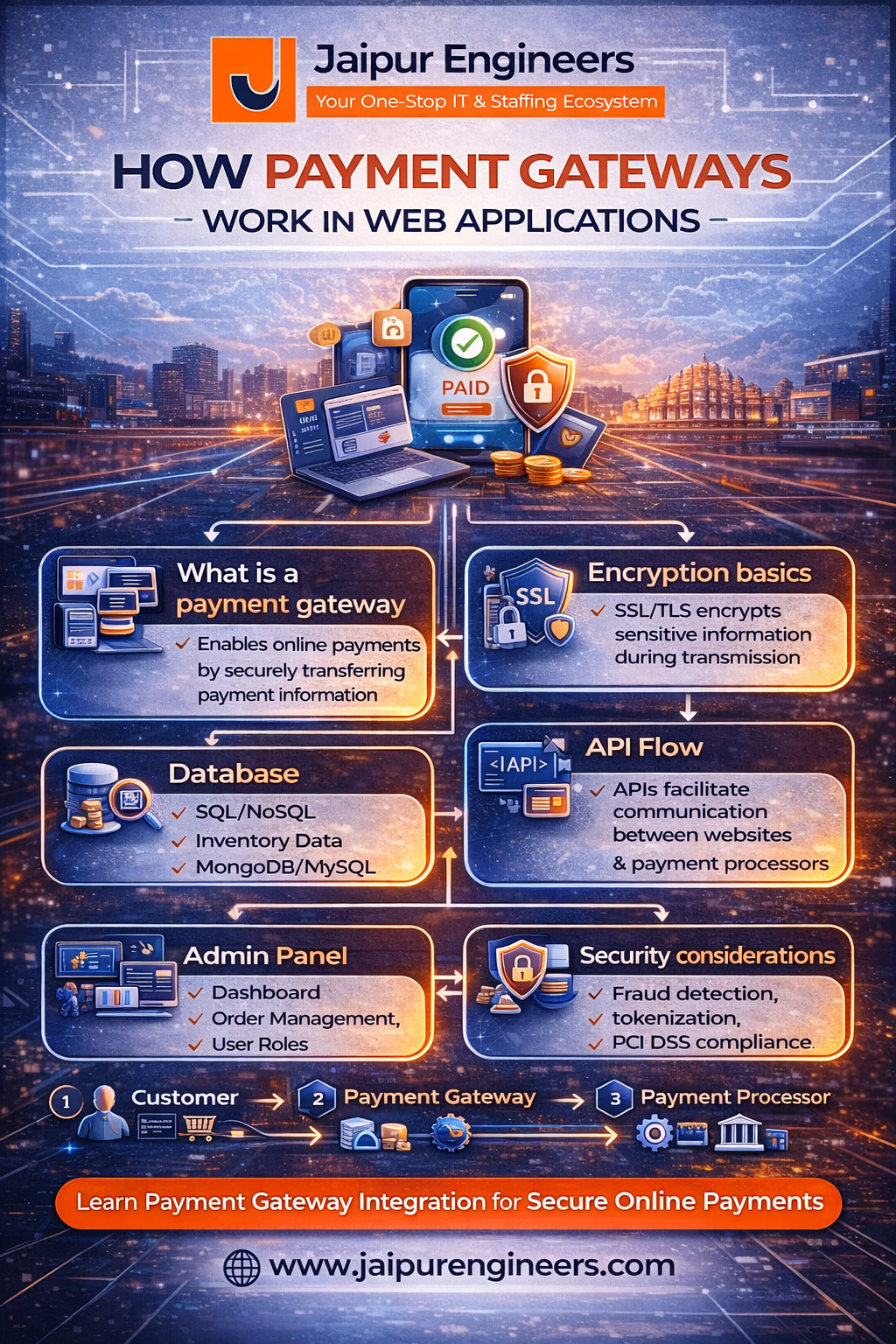
What Is a Payment Gateway?
A payment gateway is a technology that securely processes online transactions between customers, businesses, and banks.
It acts as a bridge between:
- Customer’s payment method (card, UPI, net banking)
- Merchant’s website or app
- Bank or financial institution
The main purpose of a payment gateway is to authorize and securely transfer payment information.
How Online Payments Work (Step-by-Step Flow)
Understanding how online payments work requires looking at the transaction flow.
Step 1: User Initiates Payment
The customer enters payment details on the checkout page.
Step 2: Data Encryption
Sensitive information (card number, CVV, etc.) is encrypted using secure protocols.
Step 3: Payment Request Sent to Gateway
The web application sends encrypted data to the payment gateway via an API.
Step 4: Bank Authorization
The gateway communicates with the issuing bank to verify:
- Card validity
- Available balance
- Fraud detection checks
Step 5: Response Returned
The bank sends approval or rejection back through the gateway to the web application.
Step 6: Transaction Confirmation
The user receives confirmation, and the order is processed.
This entire process usually happens within a few seconds.
Encryption Basics
Security is critical in payment gateway integration.
Common security mechanisms include:
- SSL/TLS encryption
- Tokenization
- Secure hash algorithms
- Two-factor authentication (2FA)
Encryption ensures that sensitive payment information cannot be intercepted or misused during transmission.
API Flow in Payment Gateway Integration
Payment gateway integration relies heavily on APIs.
Typical API flow:
- Application sends payment request
- Gateway processes the request
- Gateway returns transaction status
- Application updates order status
Developers must handle:
- Success responses
- Failed transactions
- Pending states
- Refund requests
- Webhooks for asynchronous updates
Proper API handling ensures accurate and reliable transactions.
Security Considerations
Security should be a top priority when integrating payment systems.
Important considerations:
- Use HTTPS everywhere
- Validate input data
- Avoid storing sensitive card details
- Implement proper authentication
- Monitor suspicious activity
- Follow compliance standards
Secure coding practices reduce the risk of fraud and data breaches.
Conclusion
Payment gateway integration is a crucial component of modern web applications. Understanding how online payments work helps developers build secure and reliable systems.
From encryption basics to API flow and security best practices, every step plays a role in ensuring smooth digital transactions.
For students and developers, learning payment gateway integration is an essential skill in today’s digital economy.