Introduction
Food delivery applications have transformed the restaurant industry. Platforms connect customers, restaurants, and delivery partners in real time. But how does food delivery app development actually work behind the scenes?
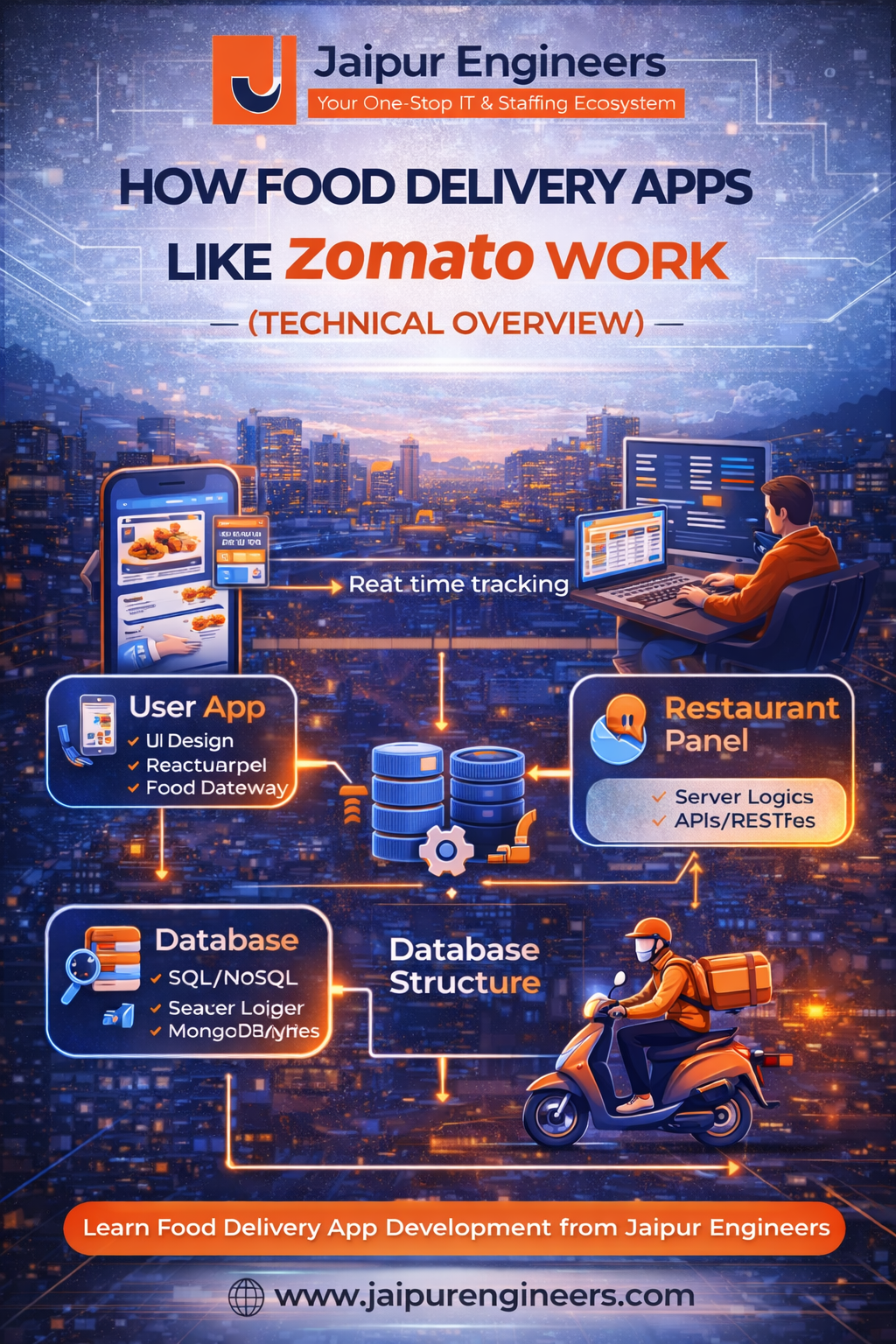
In this blog, we explore the technical architecture of food delivery apps, including user apps, restaurant panels, delivery partner modules, real-time tracking, and database structure.
1. User Application (Customer App)
The user app is the frontend interface that customers interact with.
It includes:
- User registration and login
- Restaurant browsing
- Menu listing and search filters
- Cart and checkout system
- Order tracking
- Ratings and reviews
Frontend technologies commonly used:
- React Native / Flutter (for mobile apps)
- React / Angular (for web apps)
The goal is to provide a smooth and fast ordering experience.
2. Restaurant Panel (Vendor Dashboard)
The restaurant panel allows restaurant owners to manage their operations.
It includes:
- Menu management
- Price updates
- Order acceptance or rejection
- Preparation time updates
- Sales reports
This panel communicates with the central backend server through APIs.
3. Delivery Partner Module
Delivery partners use a separate app to manage deliveries.
It includes:
- Login and profile management
- Order notifications
- Navigation integration
- Status updates (picked up, delivered)
- Earnings dashboard
The delivery module relies heavily on real-time communication between backend servers and mobile devices.
4. Real-Time Tracking System
Real-time tracking is a critical part of app architecture.
It works using:
- GPS integration
- Location APIs
- WebSockets or real-time communication protocols
- Background services for location updates
Customers can see delivery partner movement live on the map, improving transparency and user experience.
5. Backend & App Architecture
The backend acts as the central brain of the system.
It handles:
- User authentication
- Order processing
- Payment integration
- Notification services
- Load balancing
- Data synchronization
Typical architecture includes:
- API layer
- Application servers
- Database servers
- Notification services
- Cloud hosting environment
Scalability is critical because thousands of orders may be processed simultaneously.
6. Database Structure
The database stores structured information such as:
- User profiles
- Restaurant details
- Menu items
- Orders and transaction records
- Delivery partner details
- Location history
Relational databases are often used for transactions, while NoSQL databases may handle real-time tracking and caching.
A well-designed database ensures fast queries and reliable performance.
Conclusion
Food delivery app development requires coordination between multiple modules — customer app, restaurant dashboard, delivery partner system, backend servers, and real-time tracking.
A strong app architecture ensures scalability, security, and performance.
For students and developers, understanding how food delivery apps work provides valuable insight into large-scale system design and real-time application development.