Introduction
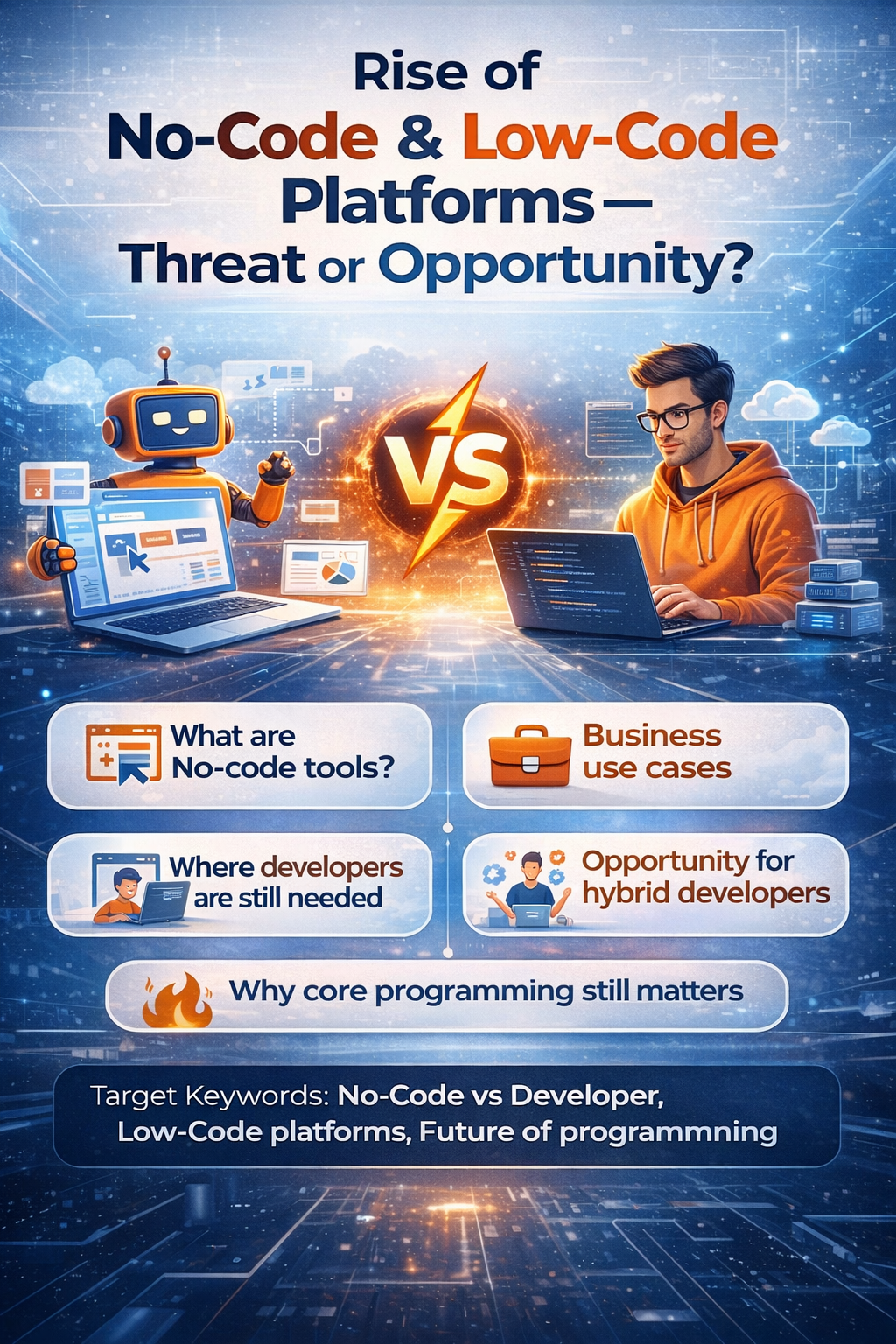
The software industry is evolving rapidly. Over the last few years, No-Code and Low-Code platforms have transformed how applications are built. Many business owners and even developers are asking an important question: Is the rise of No-Code & Low-Code platforms a threat to traditional developers, or is it an opportunity?
In this blog, we will explore the difference between No-Code vs Developer approaches, real business use cases, where developers are still essential, and why the future of programming still depends on strong core coding skills.
What Are No-Code Tools?
No-Code tools allow users to build websites, mobile apps, automation workflows, and software solutions without writing traditional code. These platforms provide drag-and-drop interfaces, pre-built templates, and visual development environments.
Low-Code platforms, on the other hand, require minimal coding. They allow developers to speed up development by using visual components while still writing custom logic where needed.
Examples of What No-Code & Low-Code Can Build:
- Business websites
- Internal dashboards
- CRM systems
- Workflow automation tools
- Simple mobile applications
These platforms reduce development time and make technology accessible to non-technical users.
Business Use Cases of Low-Code Platforms
Many startups and small businesses use Low-Code platforms to quickly launch products and validate ideas.
1. Rapid MVP Development
Entrepreneurs can build Minimum Viable Products (MVPs) quickly without hiring a full development team.
2. Internal Automation
Companies use No-Code tools to automate HR processes, attendance systems, reporting dashboards, and lead management.
3. Cost Reduction
Small businesses reduce development costs by avoiding large technical teams for basic solutions.
4. Faster Deployment
Low-Code platforms enable faster deployment cycles, helping companies stay competitive in fast-moving markets.
Clearly, No-Code and Low-Code platforms are solving real business problems.
No-Code vs Developer: The Real Difference
The debate of No-Code vs Developer is not about replacement. It is about capability and scalability.
Where No-Code Works Well:
- Simple applications
- Limited user base
- Standard workflows
- Pre-defined features
Where Developers Are Still Needed:
- Complex enterprise applications
- High-performance systems
- Custom integrations
- Advanced security requirements
- AI/ML model deployment
- Scalable cloud architecture
When systems grow, require optimization, or demand customization, traditional programming becomes essential.
The Future of Programming: Evolution, Not Elimination
The future of programming is not about removing developers. It is about changing their role.
Developers are no longer just coders. They are:
- System architects
- Problem solvers
- Integration specialists
- Performance optimizers
- Security engineers
Low-Code platforms may reduce repetitive coding, but they cannot replace deep system design, data structures, algorithms, and backend architecture knowledge.
Strong fundamentals in programming languages, databases, APIs, and system design will continue to define high-level engineers.
Opportunity for Hybrid Developers
Instead of seeing Low-Code platforms as competition, smart developers see them as tools.
Hybrid Developer = Core Programming + Low-Code Efficiency
A hybrid developer:
- Uses No-Code tools for rapid prototyping
- Writes custom backend logic when needed
- Integrates APIs and third-party services
- Optimizes performance beyond platform limits
This combination increases productivity and business value.
Developers who understand both traditional programming and Low-Code platforms will dominate the market.
Why Core Programming Still Matters
Even in a Low-Code world, core programming remains critical because:
- Platforms have limitations.
- Customization requires code.
- Scalability demands architecture knowledge.
- Security requires deep technical understanding.
- AI and data-driven systems need strong logic foundations.
If you understand data structures, algorithms, backend logic, and system design, you will never be replaced by a drag-and-drop tool.
No-Code platforms build interfaces.
Developers build systems.
Conclusion: Threat or Opportunity?
The rise of No-Code & Low-Code platforms is not a threat to developers who are continuously learning. It is an opportunity.
The real risk is not No-Code tools.
The real risk is weak fundamentals.
The future belongs to developers who:
- Master core programming
- Understand system design
- Learn Low-Code platforms
- Focus on solving real business problems
Technology evolves. Programming evolves. But logical thinking and strong fundamentals will always stay in demand.
If you want to secure your future in programming, focus on building deep technical skills while adapting to modern development tools.
That is how you stay ahead in the future of programming.