If you are planning to start a career in software development, one of the first programming languages you will come across is Java. For more than two decades, Java has remained one of the most popular, reliable, and widely used programming languages in the world. From banking software and enterprise applications to Android apps and cloud-based systems, Java powers millions of applications that people use every day.
Before learning advanced technologies like Spring Boot, Hibernate, Microservices, or Java Full Stack Development, every developer should first understand Core Java. It provides the fundamental concepts required to write efficient, secure, and scalable Java applications.
Whether you are a student, graduate, or working professional, this beginner’s guide explains everything you need to know about Core Java, including its features, architecture, applications, syllabus, career opportunities, salary expectations, and why learning Core Java is still a smart career choice in 2026.
What is Core Java?
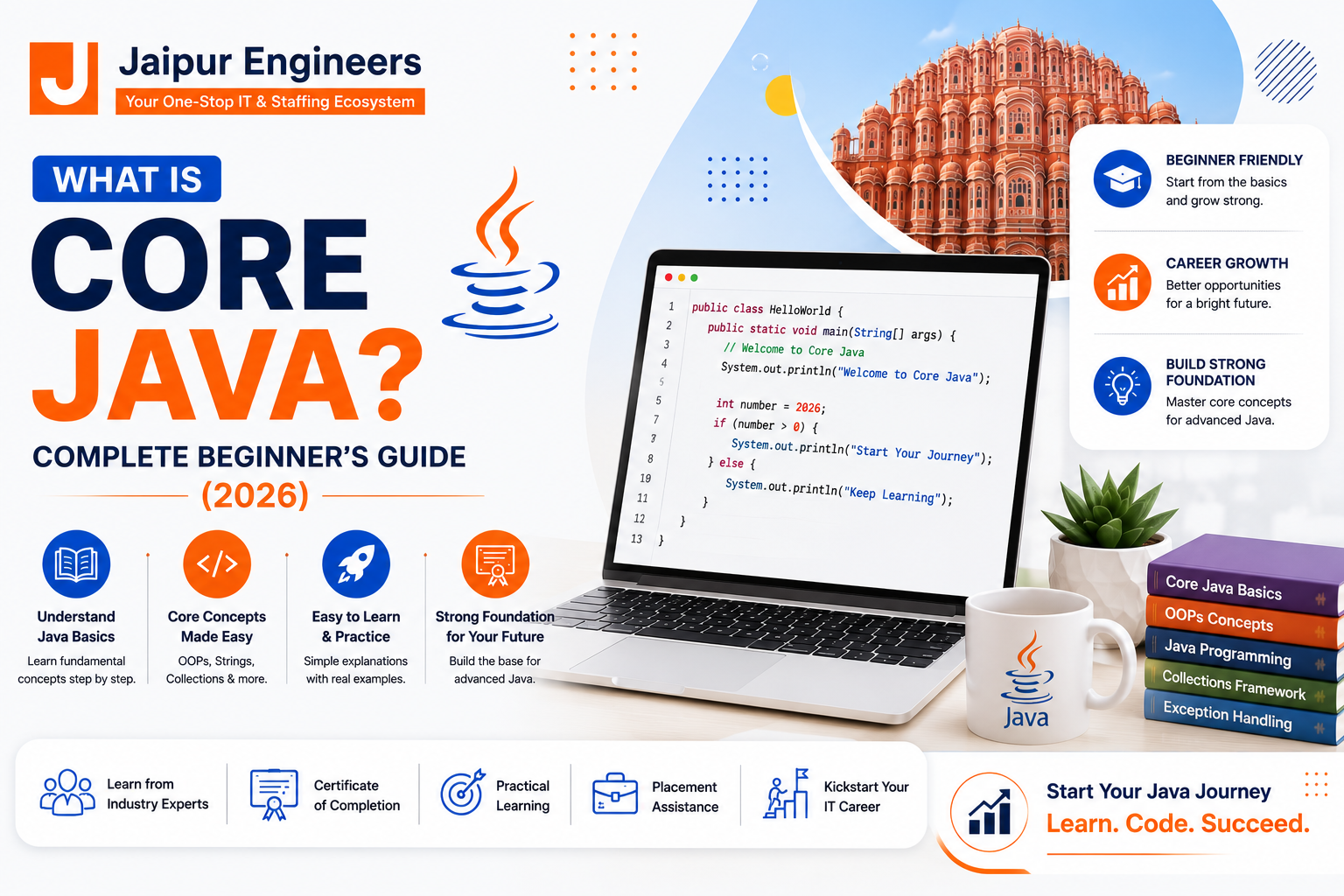
Core Java is the fundamental version of the Java programming language that focuses on the basic concepts required to build standalone applications. It includes essential programming concepts such as variables, data types, operators, control statements, loops, methods, arrays, object-oriented programming (OOP), exception handling, collections, multithreading, and file handling.
In simple terms, Core Java is the foundation upon which all advanced Java technologies are built. Without understanding Core Java, learning frameworks like Spring Boot, Hibernate, Servlets, JSP, or Java Full Stack Development becomes much more challenging.
Core Java follows the principle of “Write Once, Run Anywhere (WORA)”, meaning Java applications can run on any platform that supports the Java Virtual Machine (JVM).
Why is Core Java Important?
Core Java forms the backbone of modern Java development. Every Java developer, regardless of specialization, starts by learning Core Java because it introduces the concepts used in almost every Java application.
Some key reasons to learn Core Java include:
- Strong programming foundation
- Easy transition to Advanced Java
- High demand in the software industry
- Excellent career opportunities
- Platform-independent programming
- Large developer community
- Used in enterprise applications
- Ideal for beginners
Learning Core Java also improves logical thinking, problem-solving skills, and coding best practices, making it an excellent first programming language.
Features of Core Java
Java has remained relevant because of its powerful features.
Platform Independent
Java programs run on any operating system using the Java Virtual Machine (JVM).
Object-Oriented
Java follows object-oriented programming principles such as Encapsulation, Inheritance, Polymorphism, and Abstraction.
Secure
Java includes built-in security features like bytecode verification, automatic memory management, and runtime security.
Robust
Exception handling and garbage collection make Java applications more reliable and stable.
Multithreading
Java supports running multiple tasks simultaneously, improving application performance.
High Performance
The Just-In-Time (JIT) compiler helps optimize execution speed.
Portable
Java applications can be easily moved between different operating systems without modification.
Scalable
Java is widely used for developing applications ranging from small desktop tools to large enterprise systems.
Components of Java
Every Java program relies on three important components:
| Component | Description |
|---|---|
| JDK | Java Development Kit used to develop Java applications |
| JRE | Java Runtime Environment required to run Java applications |
| JVM | Java Virtual Machine that executes Java bytecode |
Understanding the relationship between JDK, JRE, and JVM is essential for every Java programmer.
Applications of Core Java
Core Java is used in a wide range of industries and software applications.
Common applications include:
- Banking Systems
- ERP Software
- Hospital Management Systems
- E-commerce Platforms
- Android App Development
- Desktop Applications
- Web Applications
- Cloud Computing
- Financial Software
- Government Applications
Java’s reliability and scalability make it a preferred choice for enterprise software development.
Why Learn Core Java in 2026?
Even with the rise of newer programming languages, Java continues to be one of the most in-demand skills for software developers.
Reasons to learn Java in 2026:
- High industry demand
- Excellent salary packages
- Long-term career stability
- Strong community support
- Enterprise software dominance
- Easy integration with databases
- Foundation for Spring Boot and Microservices
- Global job opportunities
Core Java Syllabus Overview
A typical Core Java course includes:
- Java Introduction
- JDK, JRE & JVM
- Variables & Data Types
- Operators
- Control Statements
- Loops
- Methods
- Arrays
- Object-Oriented Programming
- Constructors
- Strings
- Exception Handling
- Collections Framework
- Multithreading
- File Handling
- JDBC Basics
- Mini Projects
Advantages of Learning Core Java
Learning Core Java offers numerous benefits for students, fresh graduates, and working professionals. It serves as the foundation for advanced Java technologies and helps develop strong programming and problem-solving skills.
Key Advantages
- Easy to Learn for Beginners
- Platform Independent (Write Once, Run Anywhere)
- Object-Oriented Programming Language
- Secure and Reliable
- High Demand in IT Industry
- Large Community Support
- Excellent Career Growth
- Used by Fortune 500 Companies
- Free and Open Source Development Tools
- Strong Foundation for Advanced Java Frameworks
By mastering Core Java, learners can confidently move toward technologies like Spring Boot, Hibernate, REST APIs, Microservices, and Full Stack Java Development.
Limitations of Core Java
Although Java is one of the best programming languages, every technology has certain limitations.
Some limitations include:
- Higher memory consumption compared to some modern languages.
- Desktop GUI development is less popular today.
- Requires the Java Runtime Environment (JRE) to execute applications.
- Startup time can be slower for small applications.
Despite these limitations, Java remains one of the most preferred languages for enterprise software and backend development.
Career Opportunities After Learning Core Java
Core Java opens the door to a variety of software development careers. After completing Core Java, learners can continue with Advanced Java or directly start preparing for entry-level development roles.
Popular job roles include:
- Java Developer
- Junior Software Engineer
- Backend Developer
- Application Developer
- Software Programmer
- Android Developer
- Full Stack Java Developer
- QA Automation Engineer
- Technical Support Engineer
- Software Consultant
As your experience grows, you can advance to senior positions such as Software Architect, Technical Lead, or Engineering Manager.
Java Developer Salary in India (2026)
| Experience | Average Salary |
|---|---|
| Fresher (0–1 Year) | ₹3.5–6 LPA |
| 2–4 Years | ₹6–12 LPA |
| 5–8 Years | ₹12–22 LPA |
| Senior Java Developer | ₹22–40+ LPA |
| Solution Architect | ₹40 LPA+ |
Actual salaries depend on skills, projects, certifications, company, and location.
Future Learning Roadmap After Core Java
Once you have mastered Core Java, the next step is learning advanced technologies used in enterprise software development.
Recommended Roadmap
Core Java
      ↓
Advanced Java
      ↓
JDBC
      ↓
Servlets
      ↓
JSP
      ↓
Hibernate
      ↓
Spring Framework
      ↓
Spring Boot
      ↓
REST APIs
      ↓
Microservices
      ↓
Java Full Stack Development
Why Choose Jaipur Engineers to Learn Core Java?
Choosing the right institute plays a major role in your career. At Jaipur Engineers, students receive industry-oriented training that focuses on practical implementation rather than only theoretical concepts.
Why Students Choose Jaipur Engineers
- Industry-Experienced Trainers
- Practical Live Coding Sessions
- Real-Time Projects
- Updated Industry Curriculum
- Coding Practice Every Day
- Mock Interviews
- Resume Building
- Certification
- Placement Assistance
- Flexible Weekday & Weekend Batches
- Small Batch Size
- Lifetime Learning Support
Students are trained to become confident programmers who are ready to work on real software development projects.
Who Should Learn Core Java?
Core Java is suitable for anyone interested in programming and software development.
This course is ideal for:
- 12th Pass Students
- B.Tech Students
- BCA Students
- MCA Students
- B.Sc. IT Students
- Diploma Holders
- Graduates
- Working Professionals
- Career Switchers
- Beginners with No Programming Experience
No prior coding knowledge is required.
Internal Links (WordPress)
Use these links naturally throughout the blog:
- Home: https://jaipurengineers.com/
- Java Programming Course: https://jaipurengineers.com/java-programming-course-jaipur/
- Java Full Stack Course: https://jaipurengineers.com/java-full-stack-course-jaipur/
- Placement Assistance: https://jaipurengineers.com/placement-assistance/
- Student Placements: https://jaipurengineers.com/student-placements/
- Contact Us: https://jaipurengineers.com/contact-us/
Conclusion
Core Java is the foundation of every successful Java developer’s journey. It introduces essential programming concepts such as Object-Oriented Programming, exception handling, collections, multithreading, file handling, and database connectivity, all of which are required for building modern software applications.
Whether you are a student starting your programming journey or a professional looking to switch careers, learning Core Java provides the skills needed to build a successful future in software development.
At Jaipur Engineers, we provide practical Core Java training through expert mentors, live coding sessions, real-world projects, certification, and dedicated placement assistance. Our goal is to help students become industry-ready professionals with the confidence to succeed in technical interviews and software development roles.
Call to Action
🚀 Start Your Java Programming Journey Today!
Join the Core Java Course at Jaipur Engineers and gain practical programming skills through live projects, expert guidance, certification, and placement assistance.
👉 Explore Course: https://jaipurengineers.com/java-programming-course-jaipur/
📞 Contact Us: https://jaipurengineers.com/contact-us/
Frequently Asked Questions (FAQs)
1. What is Core Java?
Core Java is the fundamental part of the Java programming language that covers basic programming concepts, Object-Oriented Programming (OOP), exception handling, collections, multithreading, and more.
2. Is Core Java enough to get a job?
Core Java provides a strong foundation. Learning Advanced Java, Spring Boot, and Full Stack development afterward significantly improves job opportunities.
3. Can beginners learn Core Java?
Yes. Core Java is one of the best programming languages for beginners because of its simple syntax and strong community support.
4. How long does it take to learn Core Java?
Most learners can complete Core Java in 2–3 months with regular practice.
5. What is the difference between Core Java and Advanced Java?
Core Java focuses on programming fundamentals, while Advanced Java covers enterprise technologies such as Servlets, JSP, JDBC, and web development.
6. Is Java still worth learning in 2026?
Yes. Java remains one of the most in-demand programming languages used by enterprise companies, banks, healthcare organizations, and cloud platforms.
7. What jobs can I get after learning Core Java?
You can work as a Java Developer, Software Engineer, Backend Developer, Application Developer, or continue toward becoming a Java Full Stack Developer.
8. Does Jaipur Engineers provide placement assistance?
Yes. Jaipur Engineers offers resume building, mock interviews, career guidance, and placement assistance.
9. Do I need prior programming knowledge?
No. The course is designed for complete beginners.
10. What should I learn after Core Java?
The recommended path is Advanced Java → JDBC → Servlets → JSP → Hibernate → Spring → Spring Boot → REST APIs → Microservices → Java Full Stack Development.